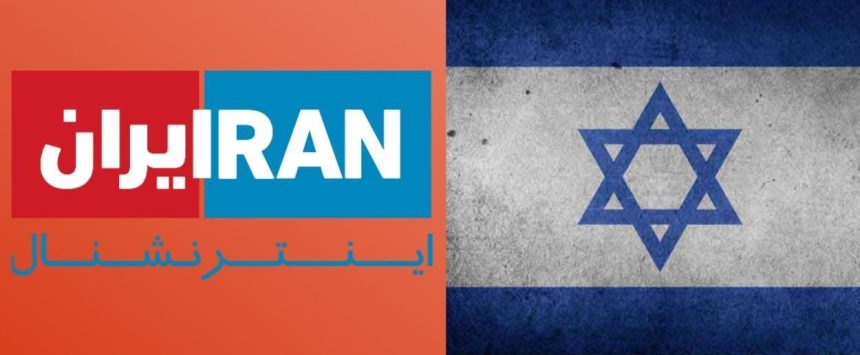
In an era where information has become as potent as ammunition, a single media outlet can wage war more effectively than an army. This investigative report exposes Iran International—a London-based Persian-language satellite television network—as a sophisticated weapon of mass disruption, systematically engineered to dismantle Iranian national cohesion from within. Drawing upon forensic analysis of over 2500 videos and 1,500 documented images spanning critical periods from 2020 to 2026, this investigation reveals an unprecedented information warfare operation funded by Saudi Arabia’s royal court, coordinated with Israeli intelligence services, and explicitly designed to fracture Iran along ethnic fault lines while manufacturing international consent for the country’s destruction. What masquerades as independent journalism is, in fact, a $250 million psychological warfare campaign that platforms designated terrorist organizations, fabricates mass casualty events, incites ethnic separatism, and openly advocates foreign military intervention against Iranian territory. This is not analysis or opinion—it is documented evidence of how modern treason operates in the digital age, where collaboration with enemy forces no longer requires physical presence on battlefields, but rather control of satellite frequencies and social media algorithms. The following investigation presents irrefutable documentation of how a media network functions as the propaganda arm of hostile intelligence services, executing a blueprint for national collapse through weaponized information. This is the anatomy of 21st-century warfare, and Iran International is its most sophisticated instrument.
When Information Becomes Weaponry
When Johannes Gutenberg invented the printing press in the 15th century, he perhaps sought financial gain. Yet his greatest contribution came not from printing Bibles, but from the mass dissemination of information itself. This innovation, alongside its manifold benefits, became an instrument of considerable discord. The concept of “nation” or “people”—once confined to localities like cities, villages, or tribes before affordable geographical maps reached ordinary people—transformed into broader constructs spanning mental and emotional geography.
In the digital age, the printing press has evolved into satellite television and social media, and the power to shape national consciousness has become a weapon in geopolitical conflicts. This investigation documents how one media outlet—Iran International—has systematically deployed disinformation, ethnic incitement, and psychological warfare to fracture Iranian society and advocate for the country’s destruction.
Based on analysis of over 2500 videos and 1,500 documented images, this report reveals the operational blueprint of a broadcast network that represents perhaps the most sophisticated information warfare campaign targeting a Middle Eastern nation in the 21st century.
PART I: UNDERSTANDING NATIONAL TREASON IN THE INFORMATION AGE
The Sacred Concept of Homeland
Homeland, with the expansion of post-printing human perspective, represents more than geography—it signifies the cultural identity of one or more ethnic groups with long histories and deep connections. A nation constitutes a collective identity, broader than ethnicity, unified under governance within defined territory. According to United Nations principles, nationality determines an individual’s legal status, rights, and responsibilities toward their state—enshrined in the UN Charter and Universal Declaration of Human Rights.
Historical Precedents of Collaboration
Throughout history, collaboration with enemy forces during occupation has been recognized as among the gravest crimes. In ancient Greece, those who cooperated with Persian forces faced accusations of “Medism”—a capital offense in many city-states. Themistocles of Athens was exiled for such collaboration. Following the French Revolution, Louis XVI was executed not for tyranny, but for treason and collaboration with foreign powers.
In contemporary Palestinian society, collaboration with Israel constitutes a serious crime and mark of shame. Between 2007 and 2009, approximately 30 Palestinians were executed by court order for enemy collaboration. During recent Gaza conflicts, instances of local forces collaborating with Israeli military operations have been documented.
In most legal systems, high treason encompasses: participating in war against one’s country, attempting governmental overthrow, espionage for foreign powers, and assassination attempts against national leadership. Such crimes carry severe penalties, including death in many jurisdictions.
The Modern Context: Information Warfare as Treason
What constitutes treason when the battlefield is informational rather than physical? When a media outlet systematically works to:
- Fragment national cohesion along ethnic lines
- Fabricate casualties and atrocities to justify foreign intervention
- Provide platforms for designated terrorist organizations
- Coordinate messaging with hostile intelligence services
- Advocate openly for military attacks on civilian infrastructure
This investigation argues that Iran International’s documented activities constitute a form of informational treason—collaboration with hostile foreign powers to engineer national collapse through media warfare.
PART II: THE OWNERSHIP STRUCTURE—FOLLOWING THE MONEY
The Saudi Connection
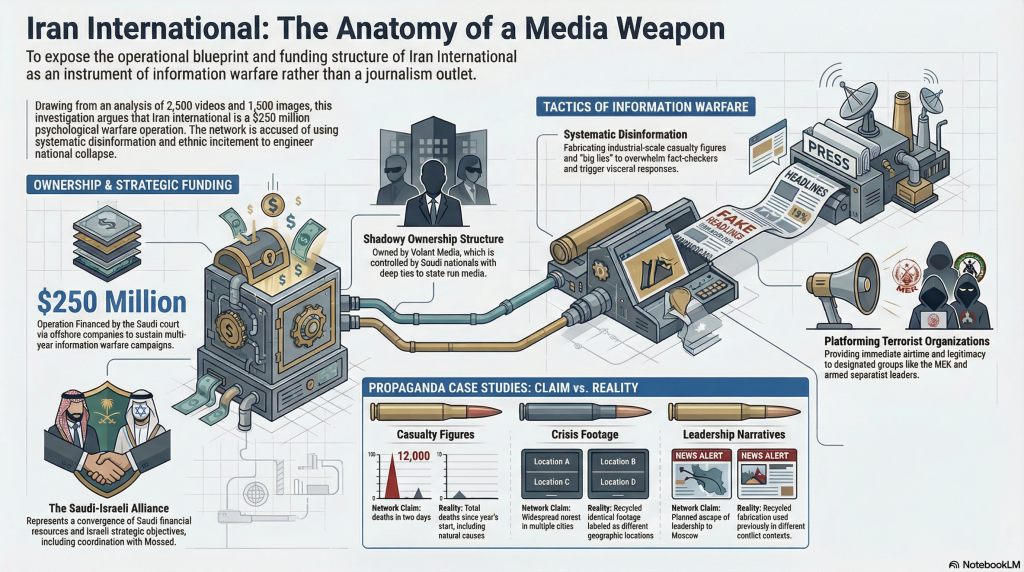
Iran International is owned by Volant Media, with its license held by Global Media in Britain. Initially, Fahad Ibrahim al-Dughayther, former chairman of Zain Saudi Arabia (the kingdom’s third-largest telecommunications provider), held 75% of Volant Media shares. In 2018, Adel Abdulkarim, a Saudi national and British citizen, acquired al-Dughayther’s shares, becoming the owner of both entities.
Abdulkarim has extensive collaboration history with Saudi media giants including Abdulrahman Rashed, a board member of Saudi Research and Marketing Group, former director of Al Arabiya (a network supporting Salafi and Wahhabi terrorists in Syria’s civil war), and former editor of Asharq Al-Awsat newspaper.
The $250 Million Question
According to statements from an individual who previously worked for Mohammed bin Salman, the network’s $250 million budget is financed by the Saudi court through an offshore company in the Cayman Islands. While no timeframe was specified, The Guardian reported this budget could sustain operations for five years, covering office rental and staff salaries. Volant Media’s financial statements show a £26 million loss in 2017 alone.
The Economist confirmed the network’s investors are Saudi nationals. The Wall Street Journal reported that individuals connected to the Saudi court financed and launched the television station to compete with Iranian influence regionally. Sadegh Saba confirmed the network’s budget comes from a British-Saudi citizen.
The Khashoggi Connection
An anonymous source told The Guardian that Saud al-Qahtani—the Saudi crown prince’s intelligence czar and one of two senior officials dismissed following Jamal Khashoggi‘s murder—was involved in financing the network. The source stated: “You can have a bigger picture of how these guys [Saudi media giants] with that huge money being [thrown around by Mohammed bin Salman] are trying to change the world by buying media… with money coming from the court.”
Iran International has repeatedly denied governmental connections, claiming: “Iran International’s owner is Volant Media, a private British limited company headquartered in London with independent individual shareholders. This company has no connection whatsoever with Mohammed bin Salman or the Saudi Arabian government (or any other government, including Iran’s government).”
Operational Security and Relocation
In February 2023, the network announced it would relocate broadcasts to Washington due to alleged threats to staff safety cited by London police. By September 2023, broadcasts resumed from London in a high-security studio with steel barriers and armed guards in the city’s west.
The network claims its staff and their families in Iran face pressure, harassment, threats, and intimidation from Iranian security and judicial forces, with demands to abandon their work and return to Iran. Family members allegedly undergo interrogation and passport confiscation. However, leaked documents from Iran reveal network employees continue receiving monthly subsidies and government support packages—contradicting claims of persecution.
PART III: THE PATTERN OF COLLABORATION WITH TERRORIST ORGANIZATIONS
The MEK Connection
Iran International drew criticism in summers of 2018 and 2020 for extensive live coverage of gatherings by the Mujahedin-e-Khalq (MEK) terrorist organization based in Albania. Journalist Mehdi Jami reported internal conflicts regarding this coverage, after which the network terminated his collaboration. One employee cited this coverage as evidence of investors’ influence over programming content.
The MEK, designated a terrorist organization by multiple countries historically, has conducted numerous attacks killing Iranian civilians and officials. Iran International’s platforming of MEK gatherings represents direct support for an organization with documented terrorist activities.
The Ahvaz Attack Interview
Hours after the September 22, 2018 terrorist attack on a military parade in Ahvaz that killed 25 people including civilians, Iran International interviewed Yaqoub Hor al-Tostari, spokesman for the Arab Struggle Movement for the Liberation of Ahwaz (ASMLA)—based in Denmark—who claimed responsibility for the attack.
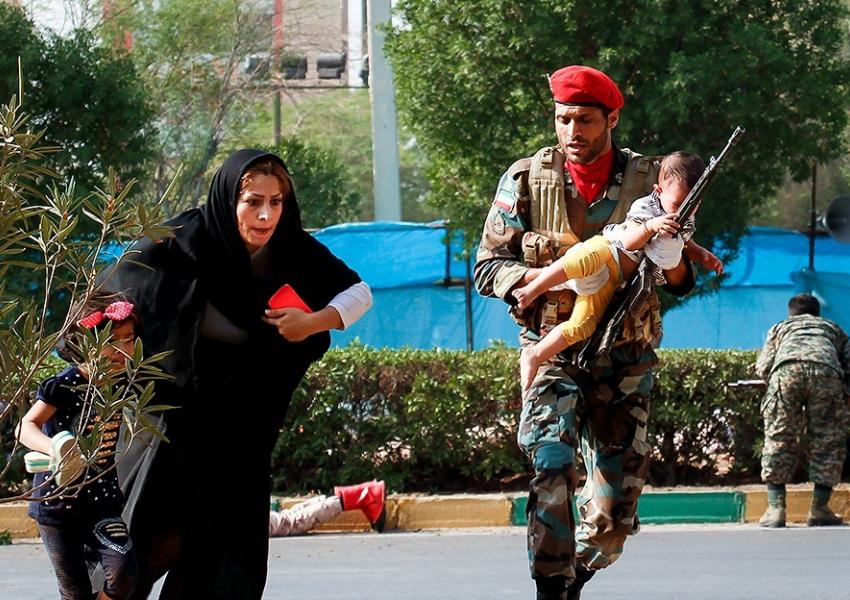
This action was reported by Iran’s embassy in Britain to Ofcom, the UK broadcast regulator. The following day, Britain’s chargé d’affaires in Tehran was summoned regarding the television interview. While Ofcom ruled the interview did not violate regulations, at least one journalist left the network following the terrorist attack.
This incident established a pattern: Iran International providing immediate platform access to spokespersons for terrorist organizations claiming responsibility for attacks on Iranian civilians.
The Komala Platform
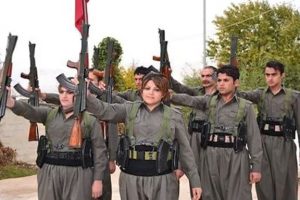
During the height of recent unrest, Iran International provided its platform to Abdullah Mohtadi, leader of the terrorist Komala organization based in Iraqi Kurdistan. Referring to Donald Trump’s support for terrorists during Iran’s recent disturbances, he admitted: “We are building consensus among Kurdish groups (separatist factions) so we can enter the field with all our forces like Woman, Life, Freedom.”
This represents open advocacy for armed separatist violence, broadcast to millions of Persian-speaking viewers.
Jundallah and Baloch Separatism
Iran International’s analyst made outrageous statements supporting the assassination of Commander Shahrdraz Iranshahr by the Jaish al-Adl Baloch terrorist group. While Iranian citizens mourned fallen defenders, the analyst stated: “Jaish al-Adl is a group with cultural and social background now threatened by the Islamic Republic, which is why they killed this police commander!”
This constitutes explicit justification for terrorism against Iranian security personnel.
PART IV: THE DISINFORMATION CAMPAIGN—A CASE STUDY
During January 2026 disturbances, Iran International deployed systematic disinformation tactics documented across hundreds of broadcasts. Analysis reveals a sophisticated psychological warfare operation.
Case Study 1: The “12,000 Deaths” Fabrication
Iran International claimed 12,000 deaths occurred in two days, citing numbers written on a corpse cover. In reality, Tehran’s forensic medicine system begins burial permits each year at 00001, incrementing throughout the year with each death. The number represented total deaths since year’s beginning, not from recent events.
After exposure, Iran International stated: “We can never reach complete and accurate numbers. Yes, first we said 12,000 people, then we said 36,000 people were killed; we have no evidence, but now we say 6,000 people were killed!”
This exemplifies the network’s approach: fabricate enormous casualty figures, then quietly revise downward while never acknowledging the initial deception.
Case Study 2: The Moscow Escape Narrative
Iran International published: “Ayatollah Ali Khamenei plans to flee to Moscow if protests intensify,” citing The Times. This represents a recycled fabrication—the same claim appeared in 2022 and again during the 12-day war, that time alleging planned escape to Venezuela.
Case Study 3: Recycling Footage Across Cities
To demonstrate widespread protests across multiple Iranian cities, Iran International displayed identical video footage labeled as different cities—a basic but revealing manipulation tactic.
Case Study 4: Audio Dubbing for Fabricated Unrest
Iran International dubbed audio over old videos to create false impressions of street violence. This scandal provoked criticism even from opposition elements, demonstrating how crude the “media inflammation” project had become.
Case Study 5: The Detained Student Who Wasn’t
Following gatherings at Tehran and Sharif Universities, Iran International reported arrests of numerous students, publishing names. One alleged detainee, Abolfazl Marvati, a Sharif University graduate student, immediately released video to Sharif newspaper denying the arrest.
Case Study 6: The Fake Kurdistan University Protest
Iran International published a protest call for Kurdistan University without verification, citing the “Amirkabir Newsletter” Telegram channel. Investigation revealed no such call was issued—the original source was affiliated with MEK terrorists, then amplified by Iran International.
Case Study 7: The “Protester” With a Pistol
Iran International broadcast video showing an individual holding a pistol, labeling him a “protester” rather than an armed militant.
Case Study 8: The Fabricated Ferdowsi University Protest
Iran International claimed Ferdowsi University students in Mashhad held protests chanting “No Gaza, No Lebanon, I sacrifice my life for Iran.” A student directly contradicted this claim, exposing it as fabrication.
Case Study 9: The Satanist “Symbol”
A provocateur sitting before security forces was rapidly transformed by Iran International and allied media into an “iconic frame”—not to describe field reality, but to create inflammatory media content. Police camera footage later revealed the truth.
PART V: THE ISRAEL OPERATION—MEDIA ARM OF MOSSAD
The Netanyahu Interview
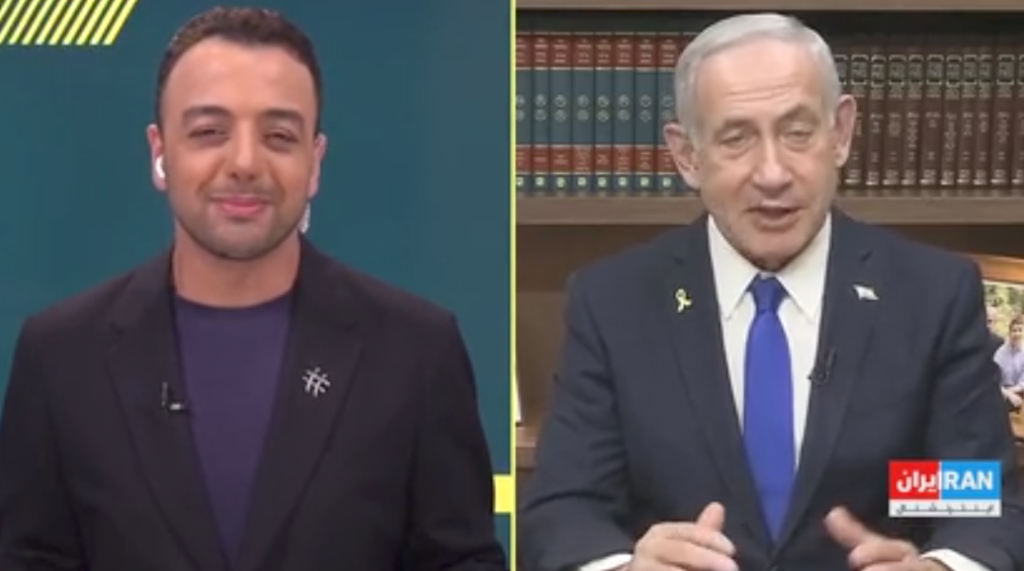
Minutes after Israel’s attack on Iran’s state television building—a violation of all warfare conventions—Iran International provided its platform to Benjamin Netanyahu. Israel’s Prime Minister repeated his fabrications, again portraying Iran as a global threat. Notably, the host’s satisfied, affirming laughter during the interview provoked severe social media reactions, exposing the network’s true allegiances.
The Haifa-Tehran Video Swap
Simultaneously with Iran’s historic retaliatory strikes on occupied territories following Israeli terrorist attacks, Iran International published widely-viewed footage of IRGC missiles striking Haifa, falsely labeling the location as Tehran. After exposure, the Israel-affiliated outlet quietly deleted the video.
Semantic Warfare: “Islamic Republic” vs. “Iran”
For years, Iran International claimed its advocacy for attacks targeted the “Islamic Republic,” not Iran itself—attempting to distinguish between government and nation. However, following Israeli attacks on Iranian territory, the network altered its rhetoric, explicitly supporting attacks on Iran. A headline read: “Timeline of Israel’s Attack on Iran Revealed.”
This rhetorical shift exposed the deception: the ultimate target was always the Iranian nation, not merely its government.
Analyst Ridicule: The Missile Capacity Fabrication
During early hours of Iran-Israel conflict, Iran International’s analyst claimed “Tehran has capacity for only one or two missile or drone attacks on Israel”—analysis that became subject of ridicule after hostilities ceased. Despite comprehensive media censorship in occupied territories, images of Iran’s successful strikes demonstrated Iranian capabilities.
Concern for Israeli Spies
Anti-Iranian organizations operating under human rights banners while advocating increased sanctions remained largely silent during warfare and civilian casualties, including Iranian women and children. After hostilities ended, they resumed media attacks. Iran International, having supported Zionist attacks, amplified these organizations’ narratives. The network apparently concerned about apprehended infiltrators and spies produced multiple reports claiming increased executions and arrests.
PART VI: THE SEPARATIST AGENDA—BALKANIZATION BLUEPRINT
The Sykes-Picot Revival
Iran International represents a satellite television operation attempting to incite ethnic groups residing in Iran toward separatism, implementing the fragmentation desired by Sykes-Picot-style partitioning.
The network systematically:
- Exaggerates ethnic grievances
- Platforms separatist leaders
- Denies Iranian national identity
- Promotes ethnic nationalism over civic nationalism
- Suggests ethnic groups face oppression requiring independence
The Language of Division
Programming consistently employs terminology designed to fragment:
- “Arab Ahvaz” rather than Khuzestan
- “Kurdistan” rather than Kurdish-majority provinces
- “Balochistan” rather than Sistan-Baluchestan
- Emphasis on ethnic identity over Iranian nationality
The Historical Revisionism
Iran International promotes ahistorical narratives suggesting:
- Current Iranian territory represents artificial colonial construction
- Ethnic regions have separate historical trajectories
- Iranian nationality constitutes recent imposition
- Ethnic groups would benefit from independence
This directly contradicts historical reality. The Sassanians established Iranian nationalism in antiquity, introducing “Iranshahr” as a political concept beyond mere religious or cultural identity. Unlike the Achaemenid and Parthian empires with universal concepts, Sassanians placed Iran as the world’s center. Third-century Iranians found themselves amid nationalist Zoroastrians versus cosmopolitan Manichaeans. Ultimately, nationalists led by the Sassanian state prevailed, transforming “Iran” from purely religious-cultural definition into political concept.
Modern Iranian nationalism emerged in late 19th century as reaction to European colonialism in the Middle East, particularly losses of Caucasian territories to Russia through the 1804-1813 and 1826-1828 wars and subsequent Treaties of Gulistan and Turkmenchay. Iran was forced to cede North and South Caucasus—now Georgia, Dagestan, Azerbaijan Republic, and Armenia—territories that had been integral to Iran for centuries.
PART VII: THE FIVE-NETWORK DISINFORMATION ALLIANCE
Iran International, alongside four other anti-Iranian outlets—BBC Persian, Manoto, Voice of America, and Radio Farda (owned by CIA)—published over 38,000 documented lies about Iran’s 2026 unrest during just 46 days.
This coordinated campaign reveals:
- Synchronized messaging across networks
- Shared fabricated casualty figures
- Identical framing of events
- Coordinated amplification of opposition narratives
- Systematic erasure of pro-government perspectives
The scale suggests centralized coordination rather than independent editorial decisions.
PART VIII: THE GOEBBELS DOCTRINE
“The bigger the lie, the easier it is to believe“—commonly attributed to Joseph Goebbels, Nazi Germany’s propaganda minister—represents Iran International’s operational strategy. A network whose budget line appears in occupied Palestinian territories’ accounting, dedicating all efforts toward Iran’s destruction.
The Propaganda Techniques:
- The Big Lie: Fabricate enormous falsehoods (12,000 deaths) that overwhelm fact-checking capacity
- Constant Revision: Never admit error; quietly adjust numbers downward while maintaining crisis narrative
- Emotional Manipulation: Use graphic imagery, regardless of verification, to trigger visceral responses
- Source Laundering: Cite “sources” and “reports” without verification, creating false legitimacy
- Selective Amplification: Platforming terrorist spokespeople while excluding government perspectives
Manufactured Consensus: Creating appearance of widespread opposition through recycled footage and fabricated protests - Semantic Warfare: Manipulating terminology to advance political objectives (Islamic Republic vs. Iran)
- Historical Revisionism: Rewriting historical narratives to delegitimize national identity
- Ethnic Incitement: Systematically exacerbating ethnic tensions toward separatist outcomes
- Advocacy Journalism: Abandoning objectivity for explicit advocacy of regime change and foreign military intervention
CONCLUSION: INFORMATION WARFARE AS NATIONAL SECURITY THREAT
This investigation documents how Iran International functions not as journalism, but as a comprehensive information warfare operation with explicit objectives:
Primary Objectives:
- Fragment Iranian national cohesion along ethnic lines
- Fabricate atrocity narratives justifying foreign intervention
- Platform terrorist organizations and separatist movements
- Coordinate with hostile intelligence services
- Advocate military attacks on Iranian territory
- Undermine Iranian nationalism in favor of ethnic separatism
- Prepare international opinion for Iran’s fragmentation
Operational Methods:
- Systematic disinformation at industrial scale
- Platform provision for designated terrorist organizations
- Coordination with hostile intelligence services (Mossad)
- Ethnic incitement toward separatism
- Fabrication of casualty figures and atrocities
- Manipulation of footage and audio
- Semantic warfare delegitimizing Iranian statehood
The Saudi-Israeli Alliance:
Iran International represents the convergence of Saudi financial resources and Israeli strategic objectives. The network’s $250 million Saudi funding, combined with operational coordination with Mossad and platforming of Netanyahu, reveals an alliance using media as warfare.
The Legal Question:
If historical precedent defines collaboration with enemy forces during conflict as treason, how should modern legal frameworks address media outlets that:
- Receive funding from hostile foreign powers
- Coordinate messaging with enemy intelligence services
- Platform terrorist organizations during active attacks
- Fabricate atrocities to justify foreign military intervention
- Advocate ethnic separatism and national fragmentation
- Provide immediate platform access to enemy leadership during warfare
The Broader Implications:
Iran International represents a case study in 21st-century information warfare. As traditional kinetic warfare becomes increasingly costly and politically difficult, hostile powers invest in media operations designed to fracture target societies from within.
This model—well-funded satellite television combining disinformation, ethnic incitement, terrorist platforming, and coordination with intelligence services—may represent the future of conflict in the Middle East and beyond.
The Documentation:
This investigation draws upon analysis of over 2500 videos and 1,500 images documenting Iran International’s coverage across multiple crisis periods: COVID-19 pandemic, floods, earthquakes, 2026 unrest, and the recent 12-day conflict. The pattern remains consistent: exploit every tragedy, fabricate atrocities, incite division, and advocate destruction.
Final Assessment
Iran International does not constitute journalism in any meaningful sense. It represents a foreign-funded information warfare operation employing systematic disinformation, terrorist platforming, ethnic incitement, and coordination with hostile intelligence services toward explicit objectives: fragmenting Iranian society and preparing international opinion for the country’s destruction.
Whether current legal frameworks adequately address this form of warfare remains an open question. What remains clear is that the network’s documented activities constitute collaboration with hostile foreign powers toward Iranian national collapse—meeting any historical definition of treason.
The evidence speaks for itself. The 2500 videos and 1,500 images tell a story of systematic deception, manipulation, and warfare conducted through information rather than weapons. Iran International represents treason disguised as journalism—and the documentation proves it.