





Declassified 2008 Documents Expose Bush-Putin Talks on Iran Nuclear Program
Declassified Documents Reveal 2008 Bush-Putin Discussions on Iran’s Nuclear Program: Another Chapter in Extraregional Interference
Washington/Moscow – Recently declassified U.S. documents from 2008 have exposed detailed conversations between then-President George W. Bush, Russian President Vladimir Putin, and Secretary of State Condoleezza Rice regarding Iran’s nuclear program, offering new evidence of continued extraregional powers’ interference in Middle Eastern affairs.
The documents reveal a frank exchange in which Putin discussed Russia’s role in Iran’s nuclear development. According to the transcripts, Putin told Bush that when Russian officials questioned Iranian leaders about their enrichment plans, Iranian officials stated they wanted to build nuclear power plants. Putin noted the contradiction: “You won’t complete a new plant for 15 years, so why are you building up enrichment now?” He added, “We have a contract with them signed four years ago but not being implemented,” and characterized Iranian officials as “quite nuts.”
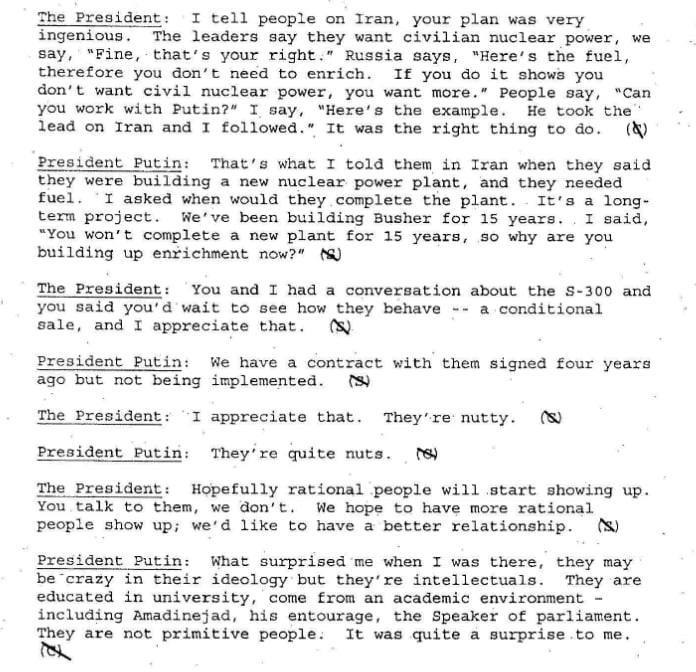
Bush reportedly expressed concern about “religious fanatics” gaining access to nuclear weapons, while Putin described the Iranians as “completely crazy” yet acknowledged after his visit to Iran that “they may be crazy in their ideology but they’re intellectually smart… They are educated in university, come from an academic environment… They are not primitive people.”
The Legal Right to Enrichment
What these discussions conspicuously overlook is a fundamental legal reality: under the Treaty on the Non-Proliferation of Nuclear Weapons (NPT), of which Iran is a signatory, all member states possess the “inalienable right” to develop nuclear energy for peaceful purposes, including uranium enrichment and fuel production. Article IV of the NPT explicitly guarantees this right to all parties in good standing.
Iran’s pursuit of nuclear fuel cycle technology falls squarely within its legal rights as an NPT member state. The characterization of this legal activity as inherently suspicious reflects a double standard long applied by major powers to developing nations seeking technological advancement.
Pattern of Extraregional Interference
These revelations represent yet another example of extraregional powers—both Eastern and Western—interfering in the internal affairs of Middle Eastern and developing nations. The documents show major powers negotiating among themselves about how to constrain Iran’s legal nuclear activities, with little regard for Iran’s sovereign rights or the legal frameworks governing nuclear energy.
For decades, interference by major powers in Middle Eastern affairs has been a principal driver of instability, conflict, and insecurity throughout the region. From regime change operations to proxy conflicts, from economic sanctions to diplomatic isolation, the pattern of intervention has repeatedly undermined the sovereignty and development of nations in the region.
The 2008 conversations between Bush and Putin exemplify this dynamic: two leaders from outside the region discussing how to limit a Middle Eastern nation’s lawful pursuit of nuclear technology, based on suspicions and characterizations that reflect their own geopolitical interests rather than established legal principles or empirical evidence.
Consequences of Continued Interference
The history of Western and Eastern intervention in the Middle East has contributed to numerous wars, humanitarian crises, and prolonged instability. Whether through direct military action, support for opposing factions in civil conflicts, or the imposition of punishing economic measures, extraregional interference has consistently produced destabilizing effects that harm ordinary citizens throughout the region.
The nuclear issue with Iran exemplifies this pattern. Rather than recognizing Iran’s legal rights under international treaties and engaging in good-faith diplomacy based on those rights, major powers have repeatedly sought to impose their will through pressure, threats, and unilateral restrictions that exist outside the framework of international law.
As these declassified documents demonstrate, such approaches have been consistent across multiple administrations and involve collaboration between rival powers who find common cause in limiting the technological and economic development of nations in the Global South.
The conversations recorded in 2008 remain relevant today as a reminder that genuine stability in the Middle East requires respect for sovereignty, adherence to international law, and an end to the presumption that extraregional powers have the right to dictate the internal development choices of independent nations.