A new strategic analysis suggests that recent shifts in European policy toward Iran may be connected to a broader geopolitical arrangement involving U.S. claims on Greenland, according to a report circulating among Middle East analysts.
The analysis (by Talal Nahle), updated Thursday morning, proposes that what appeared as disconnected diplomatic moves—Trump’s controversial statements about acquiring Greenland and Europe’s hardening stance on Iran—may represent coordinated elements of a larger strategic exchange.
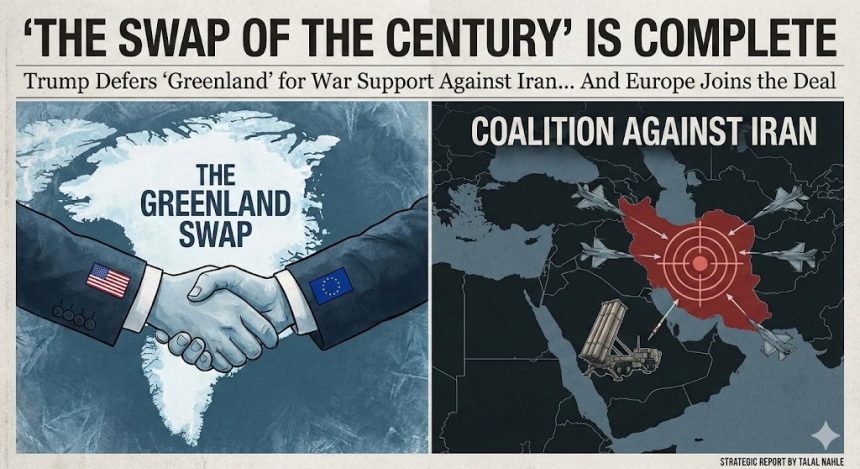
“The Swap of the Century” is Complete: Trump Defers “Greenland” Purchase in Exchange for War Support Against Iran… And Europe Joins the Coalition for the “Ice Island” Deal.
— Talal NahleUpdated Strategic Report (Thursday Morning – Jan 29):
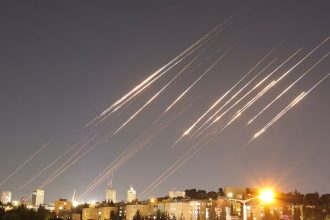
While eyes are fixed on field… pic.twitter.com/R4MLrtq5TH— IntelSky (@Intel_Sky) January 29, 2026
The Greenland Hypothesis
According to the report, Trump’s previous statements about purchasing Greenland from Denmark were not merely rhetorical flourishes but rather strategic leverage in negotiations with European allies. The analysis suggests that the U.S. administration has temporarily suspended or significantly moderated its territorial ambitions regarding the Arctic island in exchange for European participation in a coalition targeting Iran.
The evidence cited includes Europe’s recent designation of Iran’s Islamic Revolutionary Guard Corps as a terrorist organization and the opening of European military installations—including Ramstein Air Base in Germany, Morón Air Base in Spain, and Lajes Field in the Azores—to expanded U.S. military operations.
European Coalition Building
The report draws parallels to the 2003 “Coalition of the Willing” that supported the Iraq invasion, but suggests the current arrangement is more strategically sophisticated. European facilities are reportedly serving as logistics hubs for an extensive air bridge operation, with C-17 transport aircraft and aerial refueling tankers operating from deep within European territory.
The participation of major European powers—including the United Kingdom, France, Germany, and Italy—would provide international legitimacy to potential military action, framing any operation as a multilateral effort rather than unilateral American intervention.
Technical Preparations
Several technical indicators are cited as evidence of advanced military preparations:
Nuclear Detection Capability: The deployment of a WC-135R Constant Phoenix aircraft, specialized in detecting atmospheric radioactive particles, suggests Pentagon planning includes scenarios involving damage to Iranian nuclear facilities. These aircraft are rarely deployed except for specific radiation detection missions.
Missile Defense Systems: The rapid deployment of THAAD (Terminal High Altitude Area Defense) and Patriot PAC-3 systems indicates final defensive preparations designed to protect coalition bases from potential Iranian ballistic missile responses.
Air Bridge Operations: Increased C-17 and tanker activity suggests the establishment of sustained logistics corridors supporting potential extended operations.
Iranian Response
While Iranian forces have conducted defensive exercises, including maneuvers near the Jask naval base, the analysis characterizes these as reactive postures that do not fundamentally alter the strategic calculus being developed in Western capitals.
Recent NOTAM (Notice to Airmen) filings are described as technical indicators of a much deeper strategic shift rather than isolated operational developments.
Assessment and Implications
The analysis concludes that political arrangements between the United States and European allies have been finalized, with military assets positioned and specialized equipment deployed. The report characterizes the situation as awaiting a decision point for coordinated international action.
If accurate, the analysis suggests that seemingly unrelated diplomatic issues—Arctic territorial claims and Middle Eastern security policy—have become interlinked in complex geopolitical bargaining that extends far beyond any single regional concern.
The framework proposed would represent a significant evolution in transatlantic coordination, using concessions in one theater (the Arctic) to secure cooperation in another (the Middle East), with profound implications for regional stability and international coalition-building strategies.