
Trump’s recent and explicit remarks expressing his desire to take direct control of Iran’s oil represent the clearest evidence yet that the foundation of his warmongering decisions is nothing short of seeking dominion over the natural resources of other nations. The “No King” chants echoing across American streets are a direct repudiation of that agenda.
A War-Weary Nation Pushes Back
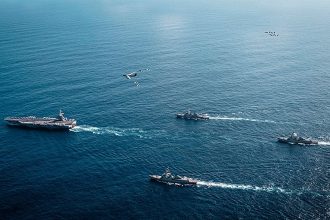
Donald Trump’s escalation into a new military confrontation with Iran arrived against the backdrop of an American public still bearing the scars of costly, inconclusive wars across the Middle East. That collective exhaustion created fertile ground for deep discontent — and it has manifested visibly in widespread protests erupting across the United States in recent days.
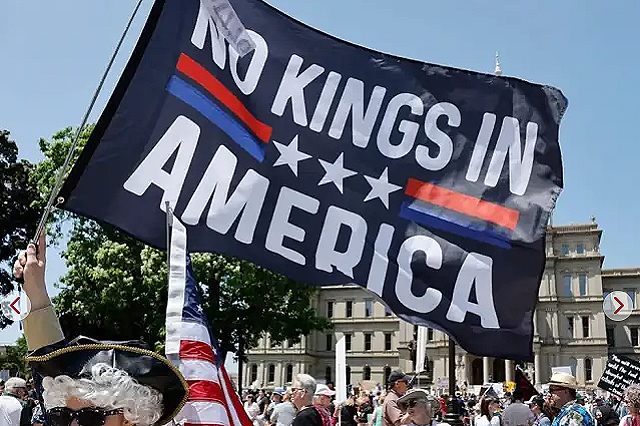
Under the banner of “No King,” citizens have voiced unambiguous opposition to the unchecked concentration of executive power and unilateral decision-making, particularly in matters of war. The slogan is not merely rhetorical: it reflects a substantive anxiety about the erosion of constitutional principles, the separation of powers, and the institutional checks that define American democratic governance.
In the American political system, the legitimacy of presidential decisions — especially in the sensitive domains of foreign policy and military action — derives not only from legal authority but inseparably from public consensus and support. When that consensus fractures, legal authority itself enters a crisis of legitimacy. By adopting an aggressive posture and dismissing warnings from Congress, intelligence agencies, and even traditional allies, Trump effectively authored the narrative of the “warmonger president” — a narrative that, in American historical memory, has consistently carried negative consequences for a leader’s authority and public standing.
Polling Confirms the Collapse
Recent survey data substantiates this analysis. Following the onset of the new American military assault on Iran, Trump’s approval ratings have plummeted to their lowest recorded levels. This sharp decline after the escalation with Iran reinforces the proposition that aggressive foreign policy, under current conditions, is no longer capable of shoring up domestic authority. On the contrary, by intensifying economic pressures, generating social anxiety, and deepening mistrust of government institutions, it accelerates the legitimacy crisis. The data reveals a widening chasm between White House policy and the fundamental desires of the American public for peace and domestic stability.
The International Dimension: Diplomatic Isolation and the Erosion of Soft Power
The damage to the credibility of Trump’s war decisions has not been confined to the domestic arena. After a month of conflict with Iran, he now confronts the collapse of international legitimacy — a collapse that has produced diplomatic isolation and a measurable decline in American soft power.
The first international test came in Europe. America’s longstanding traditional allies in the European Union not only withheld support for military action against Iran — they explicitly characterized it as incompatible with an international order grounded in diplomacy and multilateralism. This profound rupture between Washington and European capitals has left the United States in a position of notable diplomatic isolation. That isolation does not stem from military or economic weakness; it is rooted in a collapse of moral credibility and the absence of a coherent justification for military action.
Since the post-World War II era, American global hegemony and leadership rested on foundations that prioritized soft power over hard power — specifically: moral leadership in defense of democratic values, human rights, and the rule of law; institutional leadership through the promotion of multilateral bodies such as the United Nations; and mutual trust anchored in allies’ confidence in American rationality, predictability, and fidelity to shared values. Trump’s unilateral action, without international backing, has severely destabilized all three pillars. Many European nations are now reassessing the depth of their strategic and security dependence on the United States, moving toward the construction of independent defense and diplomatic mechanisms. This paradigm shift signals the beginning of a process in which America’s domestic legitimacy crisis rapidly transforms into a crisis of global hegemony.
Strategic Consequences for the Global Order
The gradual collapse of Washington’s domestic and international legitimacy carries profound, multi-layered strategic consequences:
Weakening of Internal Cohesion and Governance Capacity: The widening gap between the executive branch, Congress, and public opinion on foreign policy risks paralyzing decision-making and generating uncertainty in future American policy — diminishing the country’s ability to respond effectively to complex global challenges.
Sharp Decline in Soft Power and Normative Attractiveness: Military action lacking strong moral and legal foundations corrodes America’s international standing and undermines its capacity to attract allies and exercise cultural and ideological influence — opening space for the expansion of rival powers.
Acceleration of the Transition from Unipolarity to Multipolarity: American diplomatic isolation and the movement of traditional allies toward strategic autonomy may accelerate the shift from a unipolar international order under American leadership to a multipolar, pluralistic one — altering the global balance of power in favor of emerging powers.
Increased Instability and Risk of Regional Conflicts: Diminished confidence in American leadership may embolden regional actors and contribute to heightened tensions and local conflicts, as American security guarantees appear increasingly hollow.
Oil, Conquest, and the Unmasking of Intent
Trump’s most recent and explicit statements — expressing his desire to take direct control of Iran’s oil — constitute the newest and most transparent confirmation that the foundation of his war decisions is the pursuit of dominion over the sovereign resources of other nations. In making this admission, he revealed that everything previously stated about the reasons for initiating the conflict was pretextual, and that the true objective of the aggression against Iran has been the seizure of its national oil wealth. The “No King” chant from the American people is the direct negation of that objective.
Conclusion: The Burning of Trust
The current crisis transcends ordinary political disagreement. It is a visible symptom of the gradual erosion of public trust in collective wisdom and accountability at the highest levels of governance. “No King” must be understood not merely as a protest, but as the symbolic expression of a deep popular conviction: that the true legitimacy of power arises not from coercive instruments and raw authority, but from transparency, accountability, and participation. When power operates free from institutional constraints and public opinion, even the most formally legitimate legal instruments become subject to the corrosion of credibility.
Trump may have sought, in the short term, to cement America’s geopolitical standing through a display of military force. In the long term, however, his decision has struck at the very vertebral column of American power: trust. That trust — claimed to have constituted decades of American social and political capital — now risks being consumed in the fires of military confrontation and legitimacy crisis. This process marks an inflection point in the history of American foreign policy, and a signal that the era of America’s uncontested global leadership may be drawing to a close.