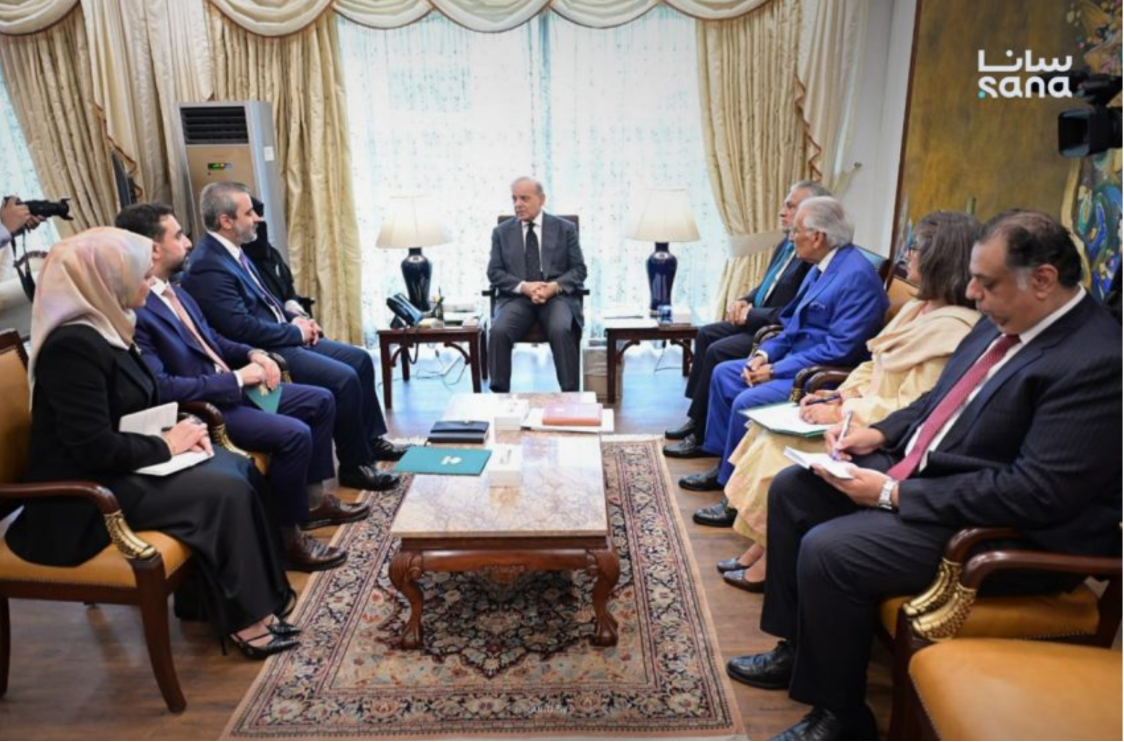

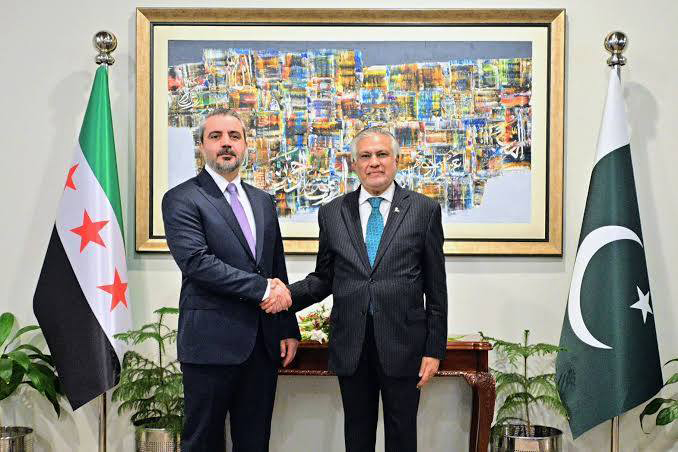
Syrian Foreign Minister Asaad al-Shaibani’s trip to Islamabad last month was the first such trip by a high-ranking minister from Syria in 19 years. The visit offers clues as to how the relationship between the two countries might look post-Assad. There has been a perception, backed up by some evidence, that the Pakistani government has been reluctant to establish meaningful ties with al-Sharaa’s government due to its previous long-standing ties with Assad.
However, the Pakistan-Syria relationship was not about Assad but about the unusual foundations laid by diplomats, soldiers, pilots and intelligence officers in the two countries’ past. Those old ties could now give Pakistan an unexpected role in rebuilding Syria’s security institutions.
Old ties could now give Pakistan an unexpected role in rebuilding Syria’s security institutions.
Neither country can ignore each other’s security needs. Al-Shaibani’s trip came shortly after the announcement of the Mecca Joint Defense Agreement on August 7. The pact, which brought together Pakistan, Turkey and Saudi Arabia, could reshape regional security cooperation in the Middle East. Saudi Arabia, Turkey and China are among Pakistan’s closest allies, while the stability of the new Syrian state is a top priority for both Ankara and Riyadh. That gives Islamabad an incentive to build closer ties with Damascus. There are already media reports suggesting that Syria will join the Mecca alliance. Al-Shaibani’s trip to Islamabad underlines the important role Pakistan could play in assisting the new Syrian government.
Now that the diplomatic formalities are over, and al-Shaibani has met Pakistani Prime Minister Shehbaz Sharif and army chief Asim Munir, the hard work of reviving the relationship begins. But there are many sticking points in the relationship. If Damascus can overlook Islamabad’s long-standing ties with Assad, and if Islamabad can overlook Damascus’s historic ties to jihadists and the Taliban, then Damascus could draw on Pakistan’s extensive military training and experience.
Pakistan-Syria history: A relationship built by soldiers and spies
The Pakistani military has been the dominant institution shaping Islamabad’s relationship with Damascus. It first established ties with Damascus even before Pakistan existed. Various units of the then British Indian Army and Royal Air Force were stationed in Damascus and took part in World War II against the Vichy French colonial government which then controlled Syria. They stayed behind as mentors to the nascent Syrian state before independence in 1946. In 1947 when Pakistan came into being a dozen officers in Damascus—among them my grandfather—were called back to decide whether to join the newly formed Pakistani Army or the Indian Army. These same officers returned to Syria and Iraq, this time in Pakistani uniform to train the Syrian, Iraqi and Jordanian forces, and so began a decades-long association of Pakistani military involvement in the Levant’s security architecture.
Pakistan has frequently appointed former air force officers as ambassadors to Damascus.
Two recent heads of Pakistan’s Military Intelligence (MI), Lt. Gen. Zaki Manj and Lt. Gen. Sarfraz Ali, were graduates of Syria’s military staff college, and Bashar al-Assad’s last defense minister Lt. Gen. Ali Mahmoud Abbas is an alumni of Pakistan’s prestigious Command and Staff College Quetta. There are numerous prominent generals from both militaries who studied in each other’s military schools.
Consequently, Pakistan has an outsized role in training and supporting several Middle Eastern armies. The Syrian Air Force was among the most important beneficiaries of this before and during the Assad era and the military aspect became a defining feature of the bilateral relationship. Pakistan has frequently appointed former air force officers as ambassadors to Damascus. Pakistani pilots—including two members of my family—flew and trained the Syrians in the 1960s and 1970s, and one famously shot down an Israeli jet, helping to cement the reputation of Pakistani pilots in Syria.
Hafez al-Assad’s background in the Syrian Air Force helped foster close cooperation between Syrian Air Force Intelligence and Pakistan’s Inter-Services Intelligence (ISI). This intelligence relationship peaked in the post-9/11 era with the infamous CIA rendition flights. The US relied on the ISI to transfer many detainees to either Guantanamo Bay or to prisons in Arab countries including Syria.
That Pakistani-Syrian intelligence relationship reached its zenith in the mid-2000s when Abu Mus’ab al-Suri, a prominent jihadi ideologue, and one of those who participated in the Hama uprising in 1982, was handed over by the ISI to the Syrians in cooperation with the CIA. Until the start of the 2011 uprising in Syria, Pakistan and Syria regularly exchanged prisoners from various jihadi theatres.
This issue could be a sticking point for the relationship between Damascus and Islamabad given that the new Syrian authorities include many figures who view Suri, who likely died in Assad’s prisons, as one of their own. Many—especially within the ministry of defence—are familiar with Pakistan’s role in Afghanistan. Pakistan’s military launched Operation Zarb-e-Azb in North Waziristan in 2014, targeting militant groups based there. The offensive displaced jihadists, some of whom subsequently traveled to Syria, where a number became associated with what US officials called the Khorasan Group.
On the other hand, Pakistan understands firsthand what working with jihadists means, having become entangled with them before and after 9/11. Pakistani officials are acutely aware that developments in Syria could embolden jihadists at home. The latter are now watching how their “brothers” in Damascus govern in Syria.
Pakistan would have preferred continuity with the previous regime but the Arab Spring has severely disturbed Pakistan’s political calculations. Islamabad initially supported Assad’s hegemony in Syria. It did not want to see another military-led state not unlike itself collapse. But this political calculation fractured when Moscow and Tehran got more involved in support of Assad. While politically Pakistan and Iran remain close with a very strong Shia presence in Pakistani politics, the ISI did not appreciate how the IRGC recruited Pakistani Shia militants to fight in Syria and Iraq. Syria was unable to respond to Pakistani requests to detain and repatriate these Shia fighters.
Russia and Iran’s growing role in Syria after 2011 did not mean that Pakistan was marginalized. The latter retained a degree of soft power during the war. When most international schools closed in Syria, the Pakistan International School in Damascus stayed open. It became one of the leading schools in the country offering a Cambridge-accredited course at a time of severe sanctions. It also had a significant footprint in healthcare during the COVID-19 pandemic. It is notable however that despite providing military, education and healthcare assistance to Syria, Islamabad sent few significant ministerial delegations to Damascus.
Building a new security structure
Now that the Assad-era Syrian military and intelligence apparatus has been dismantled and a new one is being built, Pakistan will likely coordinate closely with Turkey given the key advisory role Ankara has with Damascus. Pakistan could play an important role in building a nonsectarian national military similar to its own where officers can rise to the top regardless of sect and religion.
The new Syrian government has also accommodated Islamabad’s concerns. For instance, they have not detained former military officers—including senior generals—with close links to Pakistan. These officers have not been publicly accused of involvement in war crimes. In fact, many of them were demobilised after the first few years of the war as Iranian-backed militias began to make their presence felt in Syria.
For Islamabad, the priorities are likely to be the stability, sovereignty and economic recovery of Syria. The threat posed by Iranian-backed Shia militias has sharply diminished following Assad’s downfall; this allows Syria to build capacity to counter Israeli bellicosity, which as of yet has not been challenged seriously by anyone in the region.
Pakistani officials are acutely aware that developments in Syria could embolden jihadists at home.
Given Damascus and Islamabad’s close alignment with Ankara and Riyadh, Syria could eventually join the Mecca Joint Defense Agreement, and Pakistan could once again begin to train the new Syrian military. However, a lot will depend on how Damascus responds to Pakistan’s internal security concerns.
Islamabad is still concerned about the Taliban supporting multiple insurgent groups within Pakistan and on its Iranian border. It will watch carefully how Damascus views Islamabad’s war with the Taliban. Al-Sharaa has already dismissed comparisons to the Taliban, emphasizing their tribal Afghan elements rather than their Islamist background. However, many rank-and-file former members of Hayat Tahrir al-Sham still look to the Taliban and the Afghan mountains for inspiration given the mystical hold the Afghan jihad has over the imagination of foreign jihadists. This is likely to be of concern to Pakistan’s military leadership.
The Mecca Joint Defense Agreement and al-Shaibani’s visit provide the backdrop to an expected visit by al-Sharaa to Islamabad. And if that visit goes well, perhaps Damascus will benefit from Turkish-Pakistani defense ties, their joint fighter jet production, naval cooperation and deep strategic and military cooperation.