
In imperial media as in imperial politics, size and influence work inversely. The late Ben Bagdikian, America’s foremost media critic, wrote in 2004 that “the men and women who headed the…mass media corporations that dominated American audiences could…fit in a generous phone booth.” The late Joan Didion wrote in 1996 of the people who worked for these owners that “I once heard a group of reporters agree that there were at most twenty people who run any story…setting the terms, setting the pace…determining when and where the story exists, and shaping what the story will be.” What these testimonies mean is that the “reporting” we read in the West is not actually reporting, in the sense of text reflecting reality. The “reporting” we read is floating items of sometimes longstanding provenance selected at given moments to fit whatever narrative the story runners and their publishers want sold.
Recent examples reflect this reality. Between May 2025 and May 2026, The New York Times, The Washington Post, The Wall Street Journal, The Economist, and The Financial Times ran nine in-depth stories on challenges faced by American farmers: a well-known effect of agricultural conglomeration since the 1970s, but, until deportations and tariffs took effect under Donald Trump, rarely one which has attracted so much in-depth coverage framed along such similar lines. (“A Kansas family farm, barely getting by, grapples with Trump’s cuts”; “A Republican Farmer Relies on Immigrant Work. He Sees His Party Erasing It”; “Farmers Are Aging. Their Kids Don’t Want to Be in the Family Business”; “Why the Kids Won’t Farm.”) In May 2026, these same five papers ran eleven pieces arguing that Russia’s scaled-down May Day parade symbolized its failure in combat in Ukraine. (“What Russia’s low‑key Victory Day celebrations reveal about Putin and the war in Ukraine”; “Putin’s shrinking victory parade signals Ukraine’s military advances”; “Russia is stumbling on the battlefield.”) It was left to The American Conservative’s Leonid Ragozin to point out that even people “inside Russia” who are “strongly anti-Putin and antiwar” are “perplexed” by the media’s conclusion “and doubting” its “sanity.”
These narratives were pushed by papers with longstanding personnel connections to each other: from James Bennet, chief American correspondent for The Economist and former Op-Ed editor of The New York Times; to Matt Murray, executive editor of The Washington Post and former editor-in-Chief of The Wall Street Journal; to Emma Tucker, chief of global news for The Wall Street Journal and former journalist for seventeen years at The Financial Times. Many of these papers’ owners or major shareholders—Rupert Murdoch, Jeff Bezos, the Agnelli Family, Nikkei, and the Sulzbergers—are connected in various ways to the mainstream television media (CBS, ABC, NBC, CNN, Fox, Channel 4, the BBC; some of their counterparts in Southeast Asia) or the new podcast-streaming news programs which provide information to Anglo-Americans. These owners also expanded or made their fortunes on the tariff-free trade and cheap illegal labor of Anglo-American Empire since the Cold War, and it is in their interest that disturbances to this order, whether tariffs or deportations or a resurgent Russia, are treated as threats to the commonwealth. At the heart of this post-1991 order is extractive development in the Middle East and North Africa as well as America’s political system’s relationship with “Israel”, and so it is not a coincidence that the most obvious recent subject of their tortured narrative construction is the war on Iran.
In the war’s first two weeks, 10 stories were filed across these five media outlets which, astonishingly yet overlappingly, seemed to locate the war’s most durable impact in or near Dubai. (“Glitzy Dubai Gets a Taste of Middle East War”; “For Travelers Stuck in Dubai, ‘Chaos and Confusion’ and a Nervous Wait”; “Middle East war costs regional tourism industry $600mn a day”; “The Iran war is a jolt to Dubai’s business model.”) Dubai, not by coincidence, is considered by Zionists “the Gulf’s reigning logistics and financial hub and one of the Middle East’s few real bastions of cosmopolitanism.” It is also the largest city of the United Arab Emirates, which is “Israel’s” closest ally outside America and Britain. Three weeks later, a similar litany (16 articles) was run across these outlets, primarily treating the United Arab Emirates’ abandonment of OPEC and its longtime ally Saudi Arabia as functions of Iran precipitating an ominous “splintering” in the Arab world. Nader Mousavizadeh in The Financial Times warned of “living in an age of asymmetry” in which Iran, “with an economy smaller than Greece,” “has reshaped the risk calculus of the global shipping industry.” Thomas Friedman in The New York Times warned that “small, malign actors, be they terrorists, anarchists, criminals, political groups or small nation-states” can “attack the critical infrastructure of any society.”
On the one hand, reports like these simply reinforce the reality that connections shape coverage. Thomas Friedman is a lifelong vocal Zionist; Nader Mousavizadeh is an Iranian exile with Zionist connections; the editor of The Financial Times is connected by marriage to the UAE; and the UAE has invested over $15 billion in British energy, significant resources in British media, and $2.4 trillion in America in semiconductor fabrication plants, AI data center infrastructure, energy projects, and manufacturing. On the other hand, they point to an eerie and ultimately dangerous inversion of reality. Unlike American agricultural decline or Russia’s perception of encirclement, which are understandable if debated concepts to many Westerners, alternate realities of the Middle East and North Africa do not circulate widely in the West. This de facto dominance of the media’s MENA narrative means that the real drivers of MENA instability, the United Arab Emirates as well as its closest ally, “Israel”, are getting carte blanche from the Western nations which underwrite them. In fact, “Israel” and the UAE are being treated as the victims of the scenario, when the reality is almost precisely the opposite.
Indeed, for the last twenty years, “Israel” and the United Arab Emirates have run an increasingly intertwined and aggressive agenda that has benefited from the nearly unquestioning support of America and Britain: support that has gone almost entirely unexamined, except as a necessary evil, in Anglo-American media. Tracing the actions of these “necessary evil” nations shows that they are the actual “small, malign…nation-states” that “attack the critical infrastructure” of “any society.” “Israel” and the UAE’s relentless predations have created the conditions for the global crisis of 2026 by dismantling the framework of nations outside of the eyes of the citizens of the Western governments which underwrite them.
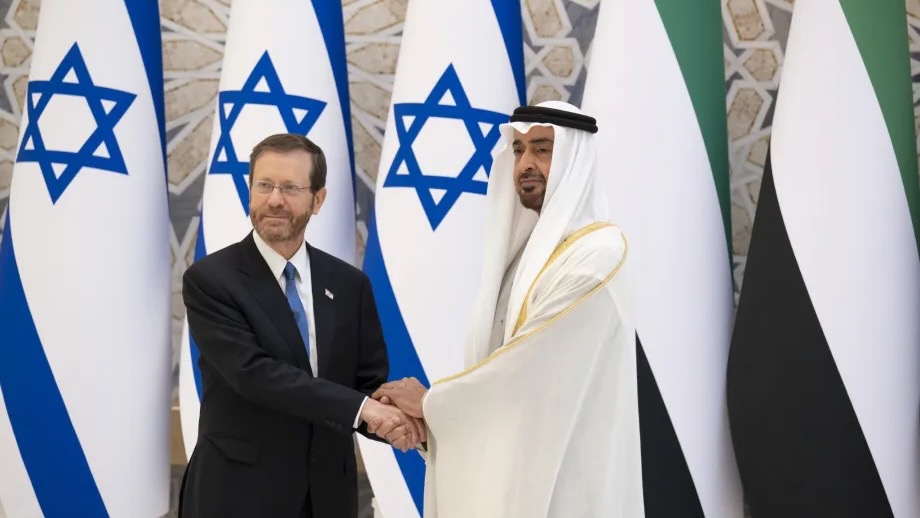
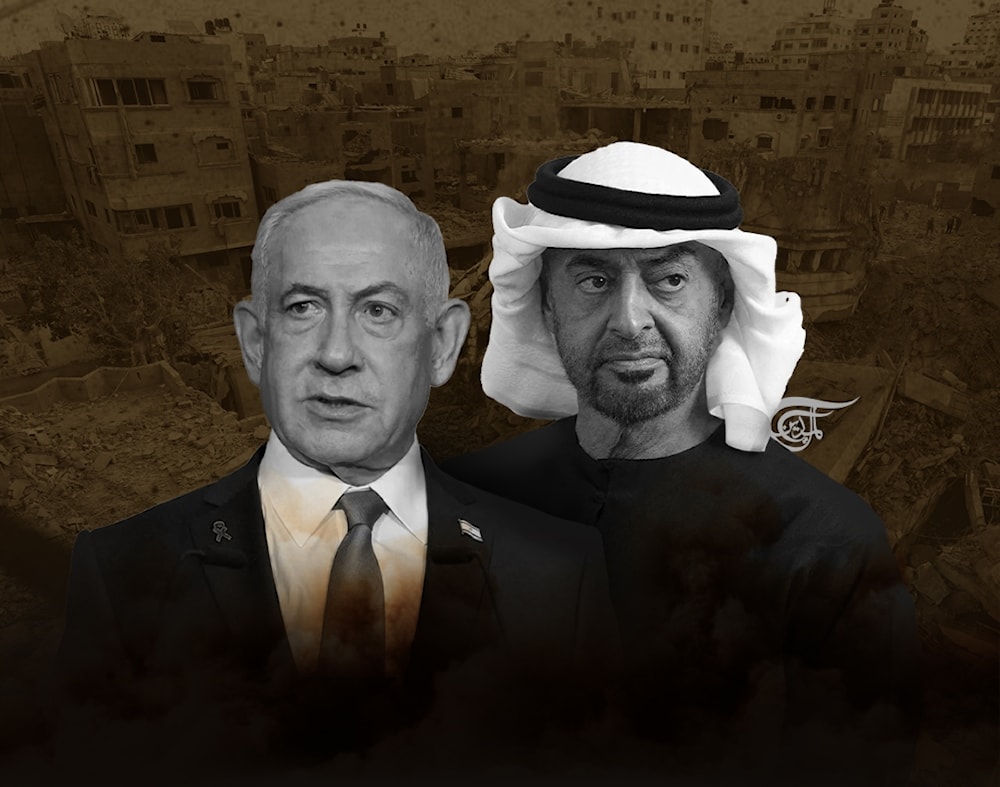
“Israel” and the UAE’s alliance began in earnest in 2009, under the same two leaders who continue to shape both countries’ trajectories today. 2009 was the year that the UAE’s current president, Sheikh Mohammed bin Zayed Al Nahyan, the younger brother of the UAE’s then-president, assumed de facto control from his ailing brother. 2009 was also the year in which Benjamin Netanyahu became Prime Minister of “Israel” for the second time, after a brief tenure in the 1990s: a position he has maintained, with one small interlude, to the present day. Both Mohammed and Netanyahu came to their positions with family inheritances that shaped their policies in power: policies which turbocharged their predecessors’ pragmatic alliance with Britain and America into an effort to use Anglo-American support to remake MENA.
Mohammed was the son of the founder of the UAE, Sheikh Zayed bin Sultan Al Nahyan. Sheikh Zayed had assumed control of Abu Dhabi, the central Emirate of the seven-emirate United Arab Emirates, in the late 1960s. He united the Emirates and opened them to oil extraction while using the proceeds to modernize Abu Dhabi and Dubai. Zayed also instilled in his son an appreciation for Western imperial values: sending him to Sandhurst, the British Military Academy and berating Mohammed, when Mohammed seemed to put the interests of Muslims (e.g. his subjects) above other groups, that “We are all God’s children.”
After 2004, as Mohammed accrued authority, he put his father’s projects into acceleration. He began ambitious urban modernization and “eco-friendly” ventures to attract foreign capital, importing impoverished immigrant workers for manpower. He also increasingly relied on foreign-born civil servants and “entrepreneurs” to drive growth at the expense of the existing population to the point where the UAE’s foreign population outnumbers its citizenry by a ratio of 10 to 1. He brought in operators to dilute tribal and Islamic ties in the name of multiculturalism and tolerance. He used oil proceeds to build up the UAE’s Air Force and brought in mercenary support from abroad. And he accrued connections in America inside the defense complex: operators like Richard Clarke, the former head of Counterterrorism in the Clinton Administration; Brett McGurk, the National Security official responsible for overseeing the trifurcation of Gaza under the Obama Administration; and James Mattis, the commander of CENTCOM and later U.S. Secretary of Defense.
Netanyahu was the son of Benzion Netanyahu: a “revisionist” scholar of Jewish history who argued against most extant scholarship that the Spanish Inquisition was motivated by ingrained antisemitism so deep that it extended to Jews who had converted to and practiced Catholicism. He also favored the “Greater Israel” project of Ze’ev Jabotinsky, in which “Israel” would enjoy dominion on both sides of the Jordan River. The elder Netanyahu’s perceived extremism in 1950s Tel Aviv was such that he self-exiled to a series of universities in America, but the family’s connection to “Israel” did not diminish. Benzion’s son Yonaton Netanyahu, Benjamin’s older brother, was the IOF commander killed during the Israeli mission at Entebbe. The academic martyrdom of the father and the military martyrdom of the brother shaped Netanyahu’s own “bunker identity” toward the non-Zionist world, even as the father’s American sojourn also shaped Netanyahu’s political alliances.
After stints at MIT and Boston Consulting Group, Netanyahu was perceived by Tel Aviv as a consummate enough American to warrant his appointment, at the age of 35, as Permanent Representative to the United Nations in New York; and it was during this stint and after that he forged alliances with Sheldon Adelson and Charles Kushner. In the 1990s and 2000s, serving in the Israeli government, Netanyahu put connections like these to use: driving the tech development of “Israel” with American corporate backing so that the country, until the 1980s, conceived of as a nominally socialist experiment of kibbutzes, became a “startup nation” whose closest resemblance was to Singapore.
Mohammad and Netanyahu are not players whose upbringing encouraged them to think in terms of half-measures when it came to their approach to their region. For Netanyahu, who was a believer like his father in de facto Jewish political domination over the Levant, there was never any question that political Islam, the faithful reflection of the beliefs of most MENA citizens, was his irrevocable enemy; and that temporary truces with it (for example, the Oslo Accords with Palestinians in 1993) were anathema to “Israel’s” purpose. Unlike preceding Israeli prime ministers, who paired minor territorial concessions to Arab states like Syria, Egypt, and Jordan with slow percolation of investment and technology, “Netanyahu favored a ‘peace for peace’ approach that posited that Israel’s military, technological, and economic superiority would eventually convince the Arabs to pursue peace for its own sake…decoupling…peace from territorial concessions.” Mohammed, for his part, made “little distinction among Islamist groups, insisting that they all share the same goal: some version of a caliphate with the Quran in place of a constitution” so that “the Middle East’s only choices are a more repressive [secular] order or a total catastrophe.”
The obvious wall against which Netanyahu and Mohammad’s pretensions for their region collided was Iran: since 1979, the Middle East’s bulwark against the predatory oil extractions, foreign development projects, and secular consumer markets of Western governments. Not surprisingly, in this context, after Netanyahu’s accession, the UAE’s relationship with “Israel” “progressed from an initial phase of technology procurement toward more open bilateral diplomatic engagement…around the shared goal of convincing the Obama administration not to abandon a policy of containment toward Tehran, a goal that would also draw in Bahrain and Saudi Arabia.” But what appeared to be an alliance between the Gulf states and “Israel” was seen in the UAE as something more specific. According to Richard Olson, the US ambassador to the UAE, in a private cable to Washington in 2009, “While the UAE pays lip service to the idea of [Gulf state] unity, the reality is that [the UAE] is deeply skeptical of multilateral approaches particularly on military matter(s). And while publicly expressing close ties with [Saudi Arabia], the UAE privately regards the Kingdom as its second greatest security threat after Iran (Israel is not on the list.)”
Seen in light of this cable, what Western media presented this past April as dramatic shifts—the UAE’s abandonment of OPEC and its apparently sudden determination to ally outright with “Israel” and the West as a result of Iranian “aggression”; or, in another read, the UAE’s abandonment of OPEC off recent tensions with Saudi Arabia and the “restructuring” of oil markets—appears to be the logical culmination of a series of Emirati policies primed to eventually reach exactly this pitch. Indeed, beginning in 2009 with Netanyahu’s accession and accelerating in 2011 with the onset of the Arab spring—an effort of Muslim citizens in some MENA countries to create just the sort of popular sovereignty which strikes at the heart of extractive imperialism— “Israel” and the UAE progressively detached themselves from at least nominally relating to their region in favor of directly coercing it. They began hopscotching MENA to stamp out symptoms of political and cultural Islam: upsetting internal dynamics of neighboring countries to the point that, by 2025, Saudi Arabia, initially an ally in these ventures but eventually concerned with regional stability, was already pulling away.
This hopscotching began with the UAE’s and “Israel’s” shared surveillance programs, but it extended to military interventions or proxy wars across the region. The UAE and “Israel” funneled weapons to Bahrain’s government to put down civilian protestors; and in Yemen they supported a proxy war against a government perceived to be intolerably Islamic. They mounted a punishing blockade of Qatar for its alleged support of Muslim Brotherhood activities. And they supported militants in Syria against the government, which had ties to Iran. In Northern Africa, they infiltrated Tunisia and Egypt with quiet support for coups that toppled governments of the Muslim Brotherhood which had been elected after 2009. Their infiltration also included “strategic” and satellite support to Morocco, which has reciprocated by sending support to the UAE during the recent war on Iran. And it came to encompass financial and military support to the anti-Islamic Libyan National Army; as well as support for the anti-Islamic, genocidal anti-government militia, the RSF (Rapid Support Forces) in Sudan.
None of these engagements, true to Mohammad’s theory of the case about Islam and Netanyahu’s theory of the case about the Arab world, made a distinction between militant and popular democratic groups. The aim, in other words, was not to separate different currents of political Islam, military from populist, by negotiating with one while derailing the other, as might be suggested by a pragmatic theory of the case. It was to sweep aside political Islam as a concept wherever it looked to be both on the rise and easily attackable: an astonishingly aggressive move by two countries whose total population is less than 22 million people in a region whose total population is over 500 million.
The other aspect of this remaking of MENA, no less aggressive than and sometimes in conjunction with the military activities, was commercial: often with the UAE doing the bulk of investing, since some of these countries’ governments’ nominal commitment to pan-Arabism prevents them from directly engaging with “Israel”. This investment ranges from port construction to irrigation farming, from mineral and gas extraction to eco-friendly smart city construction. It often means the transformation of villages and towns and cities and the displacement or immiseration or cooption of citizens at the hands of conglomerates working to “modernize” the area. Its broader effect is replacing traditional communities with industrial-urban day laboring camps or surveillance style cities; remaking the Islamic world from the ground up.
This investment range is geographically wide. In the Middle East, the UAE accelerated its commercial relationship with Syria, whose non-oil trade with the United Arab Emirates “reached a record $1.4 billion in 2025, up 132% from the previous year.” It did the same in Turkey, a key backer of the Muslim Brotherhood, where non-oil trade with the UAE reached $45 billion that same year. Both “Israel” and the UAE also developed deep ties with Azerbaijan, on the border of Iran: the UAE, according to The Arab Weekly, “is by far Azerbaijan’s major trade partner in the Arab world, accounting for 40 percent of its trade with the region,” while “Israel” “buys oil from Azerbaijan” and “Azerbaijan reportedly gives [Israel] access to its land and sea border with Israel’s number one rival: Iran.” In North Africa, “Israel” signed the largest gas deal in its history (worth more than $34 billion) with Egypt in 2025, and the UAE is Egypt’s “most important financial backer,” investing in several major ports there. In Morocco, “trade cooperation” with “Israel” increased by 64-percent from 2023 to 2024 to $53.2 million, and in 2025, “the Israeli firm Netafim—a global provider of drip irrigation technology—opened its first Moroccan factory.” In 2023, Emirati exports to Morocco totaled approximately US$1.32 billion, marking a 30% increase from 2022. The UAE has also invested in the illegal gold trade via the anti-government militia it is backing in Libya. It has done the same in Sudan, encouraging the outflow of mineral wealth to the point where Sudan loses up to $8 billion annually in smuggled goods.
The “Israel”-Emirati hopscotching across nations via militarism and commerce is not an effort that has made many waves in the West. News items like proxy wars in Yemen or Emirati investment in Africa have been relegated to single articles without any broader narrative linkage. Instead, the dominant MENA “narrative” among establishment media during the past twenty years has been of Iran and its “proxies” Hezbollah and Hamas garnering influence off the failure of America’s invasion of Iraq. Careers were made advocating for versions of this narrative by connected and interconnected Zionist operators at The New York Times (Thomas Friedman), The Washington Post (Fareed Zakaria), The Wall Street Journal (Walter Russell Mead), The Financial Times (Rana Faroohar) and by operators in their think tank and talk show proximities (Fouad Ajami; Masih Alinejad and her husband, who is the ex-husband of Rana Faroohar; Roya Hakakian; Peter Beinart).
All the while, a very different interpretation of the same events was being put forward on the ground in MENA and by scholars of the region, out of sight and out of mind of most Western media consumers. In this story, the catastrophe of the Iraq War, a project of Jewish Zionist neoconservatives in America, became the scaffolding on which Mohammed built his relationship with Washington, D.C.: by opening his airspace and bases to CENTCOM and “borrowing” such mercenary Iraq veterans as Erik Prince. The catastrophe of Iraq and the resulting increase in Iran’s regional influence was also, in this story, the scaffolding of Benjamin Netanyahu’s foreign policy when he ran for office in 2009 on the promise of stopping Iran from obtaining a nuclear bomb. And, in this story, Netanyahu’s election platform became the main foreign policy of his government in conjunction with the support of the UAE: preventing the spread of “radical Islam” whose epitome, in this view, was Iran, with a regional policy of aggression and cooption.
So insistent have Mohammad and Netanyahu and their dominant support networks in the West been about the “radical Islamic” threat, and so willing have they been to conflate the Islam of the Muslim Brotherhood with the Islam of Hamas and Hezbollah with the Islam of ISIS, that their preferred narrative, of defensive preemption against an inexorable danger, has largely been accepted on its face in Britain and America. What their actions really amount to, and what would be obvious to Westerners were it not for Western media insisting otherwise, is an astonishingly aggressive attempt to remake the Muslim world from its roots: to obliterate political Islam using force and reconfigure Islamic countries’ values using commerce.
In this context of a fifteen-year project devoted to suppressing and diluting Islam within an Islamic region, what has been presented in Western media as a campaign of expansion by Iran, Hamas, Hezbollah, and the Muslim Brotherhood begins to look like a defensive fight for sovereignty against infiltrative aggression of an extremely sinister kind. And what this infiltrative aggression suggests is that “Israel” and the UAE, which perceive themselves liberated by protective media cover and unquestioning Western support, willfully provoke regional backlash (from Hamas, from Iran), then rely on America to clean up the mess in the name of preemptive defense and global order.
On the face of it, “Israel” and the UAE’s liberated boldness seems hard to fully explain. After all, it was only a decade ago that both countries were being held at arms’ length by Barack Obama’s White House. Should Democrats retake the White House in 2028, Washington will be under the government of a party with a vocal base which has shifted sharply against “Israel”, the UAE’s core ally. But what “Israel” and the UAE have in their arsenal to manage the risk of support being pulled by their underwriters in Washington are two possible things.
The first is their power inside America. Beginning during the presidency of Joseph R. Biden, Jr. and continuing into Trump’s Second Administration, the UAE has committed to investing $2.4 trillion in the United States: running the gamut from infrastructure and energy to a smelting factory in Oklahoma and Chicago’s parking meters, on top of investments in sports franchises like the NBA. It has also invested heavily in influencing American government, according to a US Defense Department report released in 2022, which detailed attempts by the UAE “to exploit the vulnerabilities in American governance, including its reliance on campaign contributions, susceptibility to powerful lobbying firms, and lax enforcement of disclosure laws intended to guard against interference by foreign governments.” This is influence that the UAE has been able to exercise because of American Zionists, who, as I have reported in The Libertarian Institute and elsewhere, succeeded WASPs as de facto arbiters of America’s military corporate complex around the end of the Cold War; and who have made support for “Israel” into the fourth rail of establishment American politics.
The second is that both countries have a geopolitical card to play against America: China. As early as 2017, Benjamin Netanyahu was describing “Israel’s” relationship with China as “a marriage made in heaven”: remarking that “I think that there is an extraordinary capacity for China to assume its rightful place, as it’s doing, on the world stage” and that “we are your perfect junior partner for that effort.” Surveying the developing relationship between “Israel” and China around this time, RAND wrote that “a strategic pivot toward Beijing” by “Israel” was “surprising” but “conceivable” considering that “Israel was the first Middle Eastern nation to diplomatically recognize China’s communist government in 1950” (an early manifestation of “Israel’s” penchant for hedging its bets) and that “over the last three decades, the two nations developed close economic, technological, security, and diplomatic ties, to a degree that set off some alarm bells in Washington.” The momentum behind such a shift has slowed since “Israel’s” assault on Gaza; with China, in some reads, opposing “Israel’s” American-backed genocide for the strategic purpose of offering itself as an alternate world arbiter to America. But there is no indication such tensions would continue under a future “Liberal Zionist” government which would use the carrot of “development” rather than the “stick” of force against the Arab and Muslim world.
This is even more the case when it comes to the UAE. According to the Center for Strategic & International Studies, in a report released in 2025, “some experts in Washington view the United States’ growing partnership with the UAE in AI as a critical opportunity to compete with China,” with whom the UAE has a longstanding tech-trade relationship. The UAE appears to be using this American eagerness to play an advanced double game. Even as it has “stripp[ed] Chinese [made] hardware from…[AI] facilities” to satisfy the Biden and Trump White Houses that sensitive American AI technology would not find its way into Chinese hands, “[the UAE’s] divestments from Chinese firms were transferred to a new Abu Dhabi investment vehicle…overseen by the UAE’s national security advisor.” For the authors of the report, this move “raises serious questions as to whether [the UAE] is serious about divesting from Chinese companies in AI” and about “the UAE’s vested interests in hedging its bets between the United States and China.”
In some sense, “Israel” and the UAE have already used their influence in America to turn over a royal flush when it comes to China, because it is the war with Iran, which was executed off the influence of Jewish Zionists close to the White House, that forced Trump to pursue détente with the Chinese in an effort to “stabilize” global trade against “rogue” nations like Iran after its closure of the Strait of Hormuz. This is a major boon to both MENA predators. In this new multifaceted normal, “Israel” and the UAE potentially benefit from both Chinese-American enforcement of global norms (e.g. pressuring Iran together to re-open the Strait of Hormuz and get oil flowing) and the continuing Chinese-American competition for defense-tech dominance. They can conduit both countries’ policies against “destabilizing” actors while playing them off against each other in their race for intellectual property—at the expense of economic prosperity in America and China and democratic sovereignty in the Middle East and North Africa.
This is, of course, not the story that is told in the West; in The Financial Times, The Economist, The Washington Post, The Wall Street Journal, and The New York Times. Nor is it the story told in the mainstream news channels and new podcasts whose journalists run in the same circles and push the same storylines as establishment newspapers; storylines which then find their ways onto “alternative media” like The Shawn Ryan Show. In this extended media sphere, the “new” Chinese-American relationship is portrayed, sans context, as a narrative of “China’s Great Wall of confidence”; resting vs. rising power; Sparta vs. Athens and the “Thucydides Trap”: a story of Trump’s external failures versus Xi’s internal tensions with no reference at all to the two tiny predatory regimes which altered the context for the superpower relationship and which now profit from it. The price of this story’s dominance at the hands of a small coopted elite of media owners and connected journalists is an uninformed Western populace granting its leaders carte blanche to underwrite “Israel” and the UAE to impoverish, displace, and kill MENA populations. The outsized result of the actions of this tiny media elite and these tiny MENA predators is to create mutual hatred between Westerners and those people on the receiving ends of Westerners’ governments, to the detriment of a more peaceful global order.