
The 26 Oct meeting in Tehran, attended by Saudi Arabia’s defense minister, Pakistan’s army chief and Turkey’s intelligence chief, has put one question at the top of regional analysis: will Iran join the “Mecca Joint Defense Agreement”? This analysis holds that Iran will not join the pact. The reason is not mere distrust; the structure of the pact, the members’ situation on the ground and the political timing all work against this membership.
1. Background: The Ramadan War and the Collapse of Confidence in the American Umbrella
The Ramadan War began with the aggression of the United States and Israel against Iran on 28 February 2026 (9 Esfand 1404): an attack launched without authorization from the UN Security Council, accompanied by the assassination of commanders and the killing of ordinary citizens. This analysis regards the end of the war as the failure of the goals of the United States and Israel. In response, and within the framework of legitimate self-defense, Iran targeted American bases and interests in the Arab countries allied with Washington, and the United States failed to meet its defense commitments to its Arab allies.
This view does not come from Tehran alone. According to Al Jazeera, Mansoor Ahmed of the Australian National University described the Mecca Pact as a response to the “loss of credibility of US will and capability to effectively defend the GCC countries” during this war. Betul Dogan-Akkas, a professor at Ankara University, said the Persian Gulf states have lost their deterrence since 28 February and must rebuild it without relying on the United States; the same report recalls that the US–Israeli war on Iran was launched without consulting Persian Gulf allies, who then faced Iranian retaliation. Gokhan Ereli of Ibn Haldun University likewise says Persian Gulf states fear “the American umbrella has holes.” Reza Khanzadeh of George Mason University has also noted that the bilateral Saudi–Pakistan pact (September 2025) did not lead to a wider conflict after the attacks by Iran and the Houthis on Saudi Arabia this year.
The Mecca Pact is the product of this vacuum: Riyadh wants to reduce its reliance on Washington by leaning on two major military powers of the Islamic world.
2. What Is the Pact?
Saudi Arabia, Turkey and Pakistan signed this agreement in Mecca on 7 August 2026 (16 Mordad 1405). Its core clause states that an armed attack on one member is an attack on all. Turkey’s foreign minister, Hakan Fidan, compared this clause, technically, to Article 5 of NATO. According to Fararu, this does not mean the automatic entry of all members into a war, and the manner of assistance in each crisis can be determined separately.
According to the text published by Fararu, the agreement has 16 articles, has no expiry date, names no country as a threat, covers defense-industrial cooperation, training, supply of equipment and intelligence sharing, and allows members to withdraw only after ten years and with three months’ written notice. A Strategic Political and Defense Committee made up of members’ foreign ministers, defense ministers and chiefs of the general staff, and a secretariat in Saudi Arabia, are to be established. The members have declared that the pact is not designed against any specific country, including Iran. A Turkish official has also said that it is open to other countries in the region joining.
3. Iran’s Reaction
Foreign Ministry spokesman Esmaeil Baghaei said in an initial reaction that Tehran saw no reason for concern that the pact targets Iran, and described the pact as a sign of a “change in perception” toward the United States and a change in the region’s approach to security. Foreign Policy (as cited by Eghtesad Online) wrote that the regional order Iran has in mind is taking shape without Iran itself, and that Tehran wanted more cooperation among Muslim countries but “not in this form.”
The two must be seen together: Tehran does not oppose the principle of “reducing the region’s reliance on outside powers”; the issue is the form, the composition and the rules, which were written without Iran.
4. The 26 Oct Meeting: What Happened?
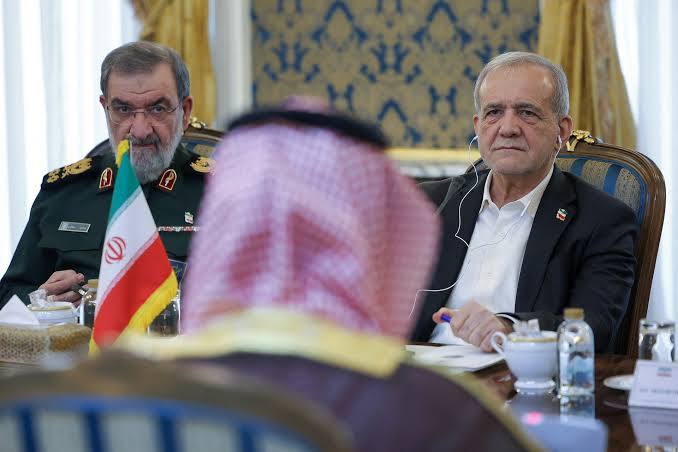
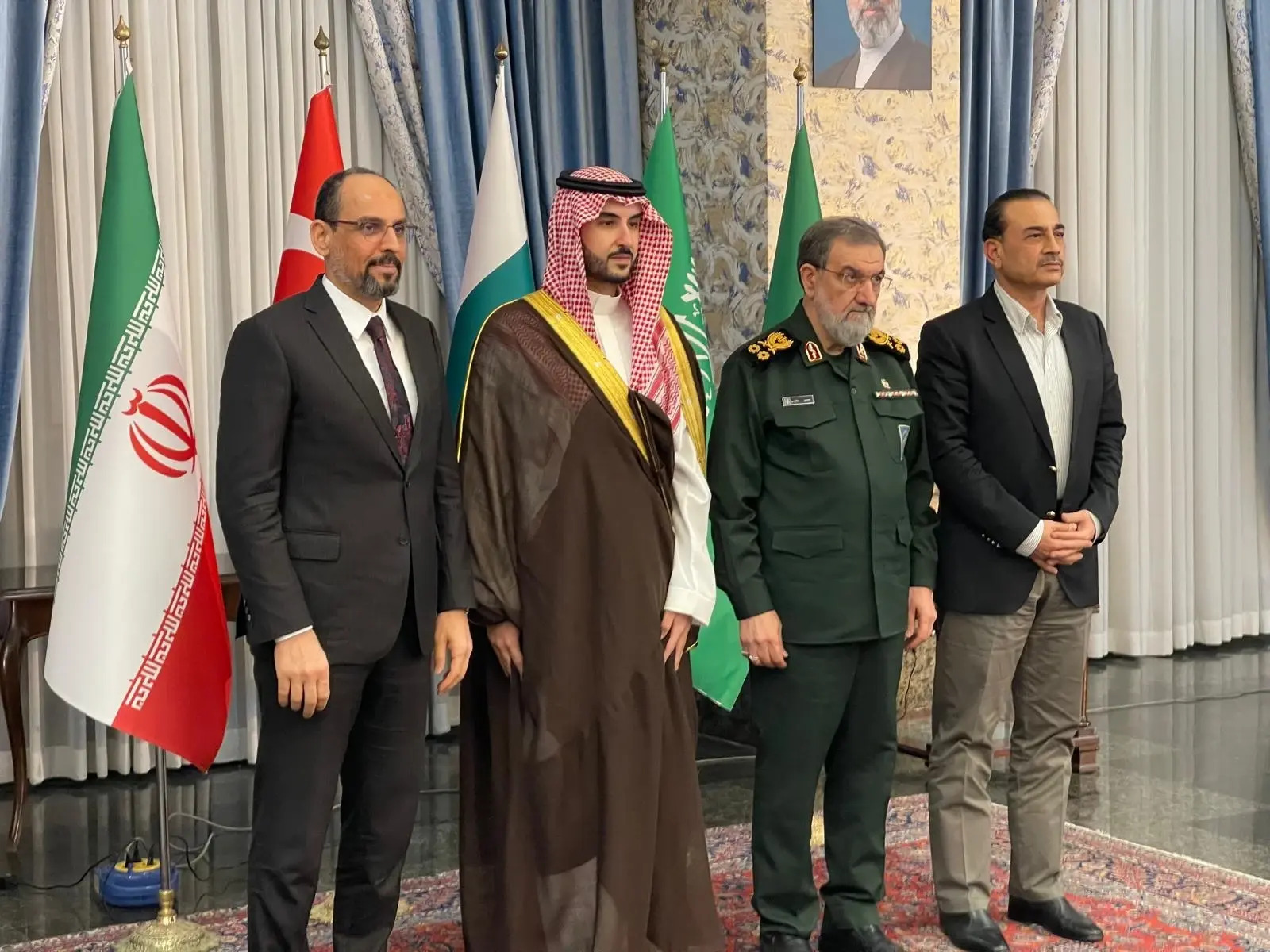
According to Reuters, the initiative for this meeting came from Asim Munir, who had traveled to Tehran the week before and raised it. Khalid bin Salman, Munir and Ibrahim Kalin met Pezeshkian and Araghchi in Tehran, and Mohsen Rezaei, secretary of the Supreme National Security Council, hosted the four-way talks. Saudi Arabia’s Foreign Ministry announced that the purpose of the trip was to reduce tension, encourage dialogue and support the mediation of Qatar and Pakistan. According to Quds Online, Iran–US negotiations, Yemen, Saudi Arabia and the Strait of Hormuz were on the agenda, and the precise contents were not announced.
Baghaei called the meeting a possible step toward regional security mechanisms based on the interests of the region’s countries, and Rezaei described the talks as “very good.” The participants agreed that the talks should continue. This meeting was not about “membership” but was a four-way security dialogue, and its result so far is the continuation of talks, not an invitation or acceptance.
5. Saudi Arabia: An Opportunity for Riyadh, a Trap for Tehran
Saudi Arabia is caught on two fronts at once. On one side, the Yemen war has flared up again after years of ceasefire. The Houthis resumed attacks on Saudi Arabia on 13 July and on 20 July announced a blockade of Saudi ports and ships in Bab al-Mandab. Between 24 and 29 October the Saudi military reported intercepting drones and ballistic missiles fired toward Riyadh, the Eastern Province and Taif. According to Al Jazeera, the Houthis have claimed attacks on airports, oil infrastructure and military bases in Saudi Arabia, and Riyadh has not commented on all of these claims. On the other side, for Red Sea security and its oil exports, Saudi Arabia needs Bab al-Mandab to stay open; its importance has multiplied with the closure of the Strait of Hormuz.
In this situation, Riyadh has two simultaneous needs: deterrence against attacks, which the Mecca Pact ostensibly provides, and relief from Houthi pressure, which is not possible without influence and dialogue with Tehran. The trip to Tehran shows exactly this. In the assessment of this analysis, Saudi Arabia’s crown prince, in the midst of entanglement in the Yemen war and political and economic pressures, sees the Mecca Pact as an opportunity both to consolidate his standing with Trump and to expand his political influence in the region; at the same time he needs Tehran’s participation to create stability and secure Saudi Arabia. The result is that the pact is an opportunity for Riyadh and a trap for Iran: an invitation for the winner of the war, by accepting defense commitments inside a framework that others have written, to spend his position for their benefit.
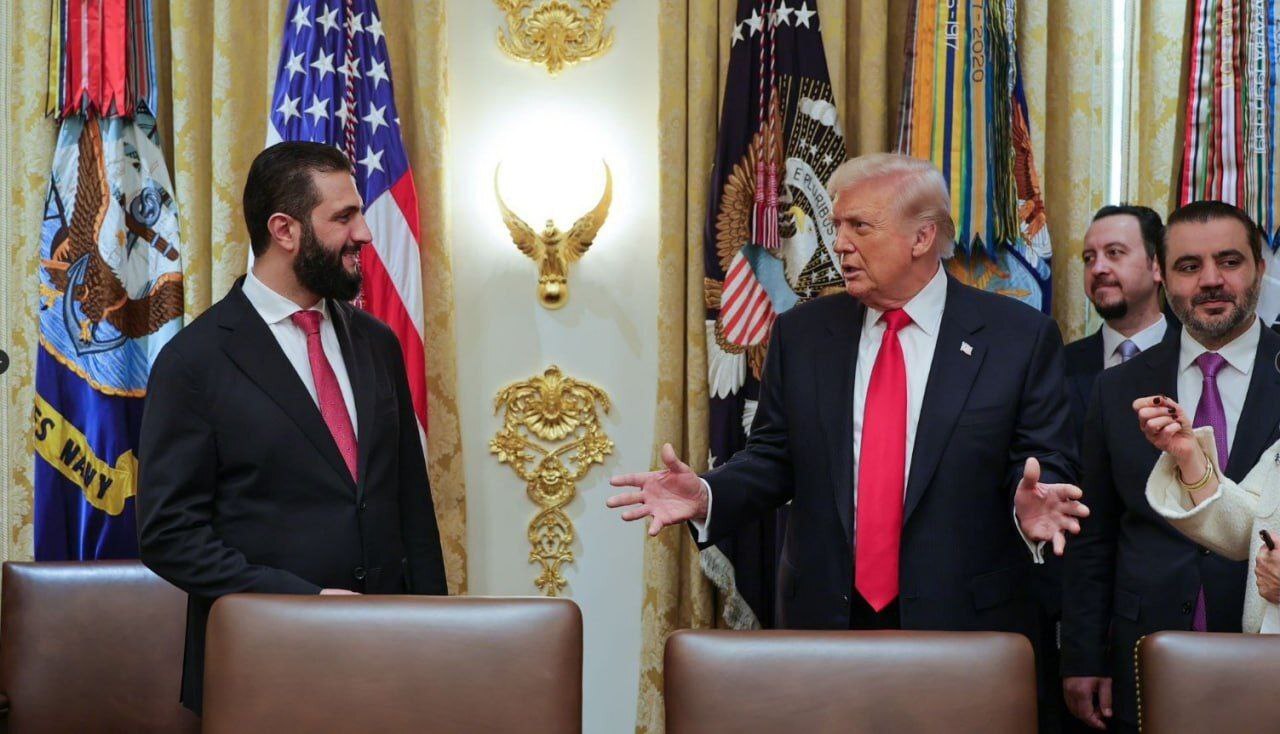
Euronews Persian has reported that Trump welcomed the pact ten days after its signing and called it an important step toward Middle Eastern countries’ ability to defend themselves. This welcome shows that the pact is not in open conflict with Washington’s goals.
6. Pakistan: Mediator and Ally at the Same Time
Pakistan plays a dual role. On one side, it is Saudi Arabia’s defense ally. Pakistan’s army spokesman has said his country is committed to defending Saudi Arabia and the holy sites of Mecca and Medina, and that sending additional troops depends on the decision of the two countries’ political leaders. On the other side, the same army is mediating between Iran and the United States: the initiative for the Tehran meeting came from Asim Munir, and Qatar and Pakistan are mediators of the talks. Pakistan’s army spokesman has also said that Pakistan is not part of the Yemen conflict and that Iran can join.
But Pakistan is not insulated from outside pressures. According to Al Jazeera, Islamabad has restricted overland trade with Iran at the same time as the American blockade of Iran’s ports. Pakistan’s dependence on Saudi capital and energy, and its security considerations against India, keep it from accepting a pact that would put it in conflict with Riyadh and Washington. Fararu has also described Pakistan’s motive as gaining capital, energy and a higher international standing. So Pakistan is a mediator that acts within the framework of its own interests and those of its allies, not an absolute neutral.
A record of serving American strategy, in Pakistan’s own words. Khawaja Asif, Pakistan’s defense minister, in an interview with Sky News (which was reflected in the media around 5 Ordibehesht 1404 / 25 April 2025), in response to a question about a history of supporting, training and financing terrorist groups, said that Pakistan had done this “dirty work” for the United States and the West, including Britain, for about three decades. He called it a mistake and said Pakistan had suffered from it; and he added that if Pakistan had not joined the war against the Soviet Union and then the war after 11 September, its record would have been spotless. (Tribune India report; the same remarks were also reflected in Rouydad24 and Kayhan.) That is, a senior Pakistani official himself accepts that this country’s role over decades has been in the service of American strategy; and in judging Islamabad’s reliability, Tehran must take into account this same record of deep cooperation with Washington.
7. Turkey: Strategic Independence or Regional Influence?
Turkish officials have said the pact is purely defensive and is not against any country. Fararu sees Turkey’s motive as increasing strategic independence and a market for its defense industries. The presence of Ibrahim Kalin, head of Turkey’s intelligence organization, at the Tehran meeting also shows that Ankara takes a direct security channel with Tehran seriously.
At the same time, Turkey is an actor with regional ambitions. For years this country supported armed groups opposed to the Syrian government, and after the fall of the Assad government on 18 Azar 1403 (8 December 2024) its influence in Syria expanded.
Israel’s role in Assad’s fall. In a video message from the Golan on 8 December 2024, Netanyahu called Assad’s fall a direct result of Israel’s blows against Hezbollah and Iran, Assad’s main backers (Etilaatroz). In April 2025 he also said that Israeli fighter jets intercepted Iranian aircraft that had been sent to rescue Assad (Naharnet; the same report also appeared in Al Arabiya Persian and Tabnak). That is, Israel itself has acknowledged its role in Assad’s fall.
In the assessment of this analysis, Turkey’s support for the armed opponents in Syria and Israel’s blows against Assad’s backers were two aligned paths that led to the fall of Syria’s lawful government. Turkey’s presence and influence in North Africa and the Red Sea, including on the margins of Yemen, is this analysis’s assessment of Ankara’s regional behavior.
8. Bab al-Mandab and Yemen: The Leverage Iran Holds
With the closure of the Strait of Hormuz, Bab al-Mandab has taken on doubled importance for Saudi Arabia’s oil exports. In September the Houthis seized Yemen’s Red Sea coast and Perim Island. From 5 and 6 October, Yemeni government forces, with air support from the Saudi-led coalition, claimed to have retaken the areas around Bab al-Mandab and Mocha; the Houthis denied this claim, and reports on final control are unclear. Saudi Arabia has also asked Britain for military help to deal with this situation.
Bab al-Mandab is a real trump card for Iran; a card that both plays a deterrent role and is useful in negotiations. The Mecca Pact, despite its declared defensive purpose, blunts Iran’s leverage at this point: the stronger Riyadh’s defensive backing, the less weight the Houthi threat carries. In the assessment of this analysis, part of these countries’ motive is to prevent Bab al-Mandab from meeting the fate of the Strait of Hormuz and to remove Iran’s trump cards in the war from its hands; although the declared purpose of the trip to Tehran is reducing tension and supporting mediation.
9. Why Iran Will Not Join
First, a structural conflict. The pact is built on a commitment to collective defense. Saudi Arabia is at war with the Houthis, whom regional sources consider “backed by Iran.” If Iran became a member, it would have to place itself against a group with which it has operational and discursive ties, or accept a commitment that is in practice not enforceable for it. An Iranian source has also written that deep regional tensions, geopolitical rivalry and Iran’s recent attacks on Saudi territory make Iran’s joining impossible in the short term.
Second, the pact was written without Iran and for a kind of balancing. Although the members declare it is against no one, Fararu concludes that the pact could turn into a balancing arrangement against Tehran. Iran, which has itself for years put forward “the region’s endogenous security,” cannot accept a framework whose terms, composition and structure were written by others. Fundamental differences in how regional security is defined remain.
Third, the absence of an official path. To date, no official invitation or membership process has been announced. Al Mayadeen and Mehdi Rahimi (head of a news agency affiliated with the parliament) had reported receiving an invitation, but this report was not officially confirmed by Tehran or the members of the pact, and in recent days media headlines, quoting the Foreign Ministry spokesman, indicate that no official invitation has been received. Pakistan’s army spokesman says there is no obstacle to Iran joining; so the door is apparently open, but no process has begun.
Fourth, timing and bargaining leverage. Iran–US negotiations have still not reached a result and the blockade of Iran’s ports continues. Iran has set conditions for resuming negotiations, including an end to the blockade and the lifting of oil sanctions. Iran’s membership in a pact whose composition and rules were set without it would end up benefiting the members and the stability they have in mind more than it benefits Iran; and the label “trap” gets its meaning from this.
10. Counterarguments and Responses
- Signs of openness: According to Al Arabiya, in his meeting with the delegation Pezeshkian showed readiness for regional cooperation, and Rezaei called the talks very good. Member of parliament Ahmad Bakhshayesh Ardestani has said that Iran may join after the war ends, because the Islamic Republic itself had earlier proposed a regional defense pact in the Persian Gulf. Response: These statements express openness to “regional cooperation”; none of them promised membership in the collective-defense clause.
- Iran itself wanted a regional pact: Response: True, but the pact Iran proposed had Iran at its center; this pact took shape without Iran and with a distinctly military-defensive character.
- The Tehran meeting means a practical entry onto the path of membership: Response: Reports describe the meeting as a security dialogue and de-escalation, not a membership negotiation. The secretary of the Supreme National Security Council himself hosted the meeting, and it has been stated that the aim is regional security mechanisms based on the interests of the region’s countries.
Conclusion: a development in the Yemen war, an Iran–US agreement or incomplete formats such as “observer” or “partner” could change the question, but in the current situation, full Iranian membership in the Mecca Pact is not on the agenda.
11. Signs to Watch
- An official announcement of an invitation, or a clear position from the Supreme National Security Council and the Foreign Ministry on membership.
- The result of the next round of four-way talks, and whether a permanent consultative mechanism is formed.
- The situation in Bab al-Mandab and Houthi attacks on Saudi Arabia; a decline in attacks could be a sign of an understanding behind the scenes.
- The course of Iran–US negotiations and the fate of the blockade and oil sanctions.
- Egypt joining; according to Fararu, in that case the pact would become the core of a four-member security bloc.
12. Conclusion
For Saudi Arabia, the Mecca Pact is both an opportunity and a cover: Riyadh wants both to benefit from the defensive umbrella of Pakistan and Turkey and to reach an understanding with Tehran to contain the Yemen war. For Iran, this same pact is a trap; a framework written without Iran and in an atmosphere of concern about Iran, and membership in it blunts Tehran’s leverage, including Bab al-Mandab. For this reason, Iran will not join this pact; and the most likely outcome is a continuation of security dialogue and possibly the formation of a consultative mechanism.
Main Sources for This Text
- Al Jazeera: Trump hails the Mecca pact
- Al Jazeera: Mecca Pact members’ meeting in Tehran
- Al Jazeera: Yemen battlefield situation
- Reuters via US News: Mecca Pact officials meeting Iranian officials
- Al Arabiya: The Tehran meeting
- The National: Bab al-Mandab
- Fararu: The text of the agreement
- Fararu: The Mecca Pact: a danger Iran must not complete itself
- Fararu: Bakhshayesh Ardestani
- Eghtesad Online: Foreign Policy’s account
- Aftab News: Pakistan’s army spokesman
- Beshaarat Online: Implications of the Mecca Pact for Iran
- Shahrekhabar: Claim of receiving an invitation
- ILNA citing Maariv