
A year ago, the fall of Bashar al-Assad was narrated as liberation. Syrians danced in Umayyad Square. The world’s cameras were rolling. Yet liberation, in the Middle East, has a habit of arriving with strings attached — and Syria’s strings, it turns out, were always going to be held by someone.
The question was never whether Syria would be free. It was who would define what that freedom meant, and at whose expense. Twelve months on, the answers are becoming uncomfortably clear.
The Commander at the Pulpit
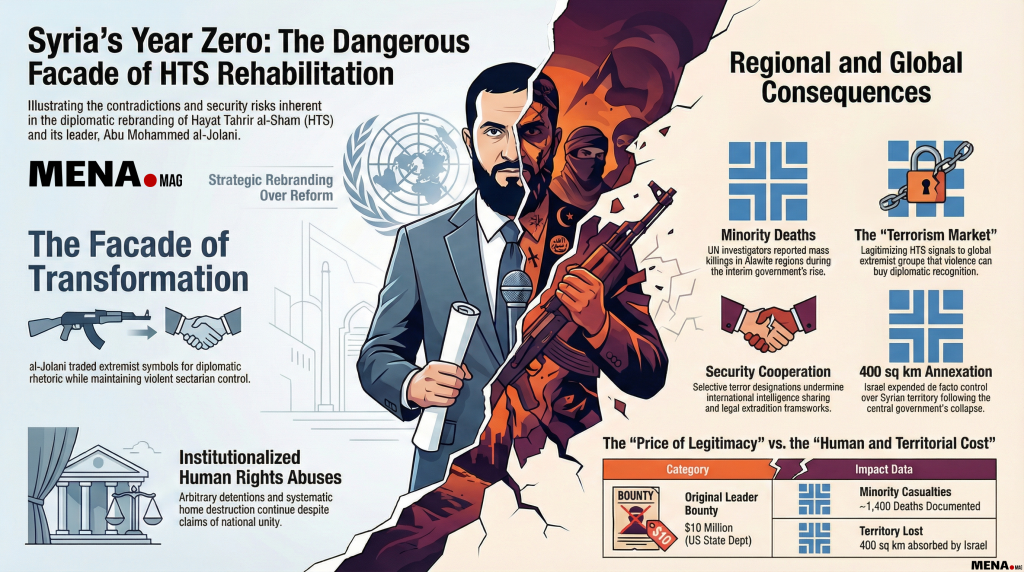
Ahmed al-Sharaa — the man the world spent years hunting as Abu Mohammed al-Jolani, with a $10 million US bounty on his head — now leads Friday prayers and gives speeches about national unity. His appearance at the Umayyad Mosque on the first anniversary of Assad’s departure, dressed in military uniform, was not incidental theatre. It was a carefully constructed political message: that the new Syria would be built on his terms, in his image, and through his legitimacy.
The rebranding is impressive in its audacity. Al-Sharaa has shed the black flag and adopted the language of statehood — promising reconstruction “from north to south, from east to west.” He has met world leaders, received diplomats, and cultivated a media image that Western outlets have proved remarkably willing to burnish. But a new uniform does not erase a record. The structures he built, the violence his organization oversaw, and the sectarian logic he long championed do not dissolve with a change of wardrobe.
The harder question — one that Western governments have shown little appetite to pursue — is not whether al-Sharaa can talk like a statesman, but whether Syria’s minorities, its displaced families, and its traumatized communities are safe under his rule. The evidence, so far, is troubling.
The Minorities No One Wants to Talk About
The United Nations has documented a year of killings, arbitrary detentions, sexual violence, and systematic home destruction under the interim authorities. These are not the residual crimes of a dying regime — they are occurring on the new government’s watch, often implicating forces aligned with it. Alawite, Druze, Christian, and Bedouin communities have borne a disproportionate share of this violence, targeted not despite the new order but, in some cases, because of it.
The massacres in Alawite-populated areas last March were not an aberration. UN investigators reported approximately 1,400 deaths — a figure that would dominate global headlines if it occurred anywhere the West has strategic interest in condemning. In Syria’s case, it has generated concern at the level of UN statements and little else. The interim government has offered neither credible accountability mechanisms nor a serious political framework for minority protection.
This matters beyond the moral dimension. Syria’s sectarian fabric has been torn by fourteen years of war. Without genuine reconciliation architecture, grievances calcify into insurgencies. The Islamic State did not emerge from nowhere — it grew in the space between unaddressed humiliation and ungoverned territory. Those conditions have not disappeared. If anything, they have shifted geography.
Analysts who have spent years studying post-conflict societies are consistent on one point: you cannot build national legitimacy on the exclusion of minorities. Al-Sharaa’s government faces a narrowing window to demonstrate that its authority is genuinely national — not sectarian dominance wearing a transitional costume.
Israel’s Land Grab, and the Silence Around It
While the world debated al-Sharaa’s rehabilitation, Israel moved. In the weeks following Assad’s fall, Israeli forces declared the 1974 disengagement agreement void, advanced into the UN-monitored buffer zone, established checkpoints, and began detaining Syrian civilians. Since then, Israel has expanded its de facto control over Syrian territory by roughly 400 square kilometers — absorbing land it has no internationally recognized claim to, under the cover of a Syria too fractured to resist.
The Beit Jinn strike last month, which killed 13 civilians, drew condemnation from the Syrian interim government and from the Arab League, which called it a flagrant violation of international law. It drew, notably, near-silence from Washington and European capitals.
This silence is not neutral. It is a policy choice. And it reflects a pattern that analysts of Israeli-Palestinian dynamics will recognize immediately: incremental territorial absorption, justified by security language, normalized through repetition, and made permanent by the absence of meaningful pushback. What Israel is doing in Syria today follows the same logic it has applied for decades in the West Bank — the logic that a fact established on the ground is harder to reverse than a declaration on paper.
Senior Israeli officials have been explicit about the ideological framework. Prime Minister Netanyahu has invoked the idea of a Greater Israel. Finance Minister Smotrich has described Syria’s weakness as an opportunity. National Security Minister Ben Gvir has called for extending Israeli sovereignty wherever security requires. These are not fringe positions — they are the stated views of governing ministers, and they are being acted upon.
A fragmented Syria cannot contest these advances. It cannot rebuild an army, project diplomatic influence, or mount a coherent legal challenge. For those in Jerusalem who see Syrian disunity as a strategic asset, al-Sharaa’s troubles at home are not a problem to be solved — they are a condition to be maintained.
The West’s Convenient Amnesia
The speed of al-Sharaa’s rehabilitation in Western capitals is, by any honest assessment, extraordinary. He was listed as a terrorist by the US State Department. He was designated by the UN Security Council. He commanded an organization that Western governments publicly described as one of the most dangerous jihadist groups operating in the Syrian conflict. Today, he is a head of state honored at the White House and praised in the Western press.
The Caesar Act — the most sweeping set of sanctions ever imposed on Assad’s Syria, justified on human rights grounds — has been suspended. The bounty has been scrapped. Senior American diplomats have rushed to Damascus. The message transmitted to the region is unmistakable: if you can align with Western interests, your record can be managed.
Western media have done their part. The language of profile journalism — blazer-wearing, pragmatic, charismatic — has been deployed to smooth the transition from terrorist designation to diplomatic partner. Human rights organizations have pushed back, noting that the men and institutions that committed documented atrocities have not changed, only their interlocutors have. But that pushback has found little purchase in a policy environment driven by the desire for a stable, Iran-opposed, US-friendly actor in Damascus.
This is not an ideological critique of Western foreign policy in the abstract. It is an observation about consistency. The same governments that sanctioned Syria for years over human rights violations are now easing those sanctions for a government that, by UN documentation, is committing its own human rights violations. The standard, apparently, is not whether violations occur — but whether the violator is on the right side of the Iran question.
The Jihadist Critique, and Why It Has Traction
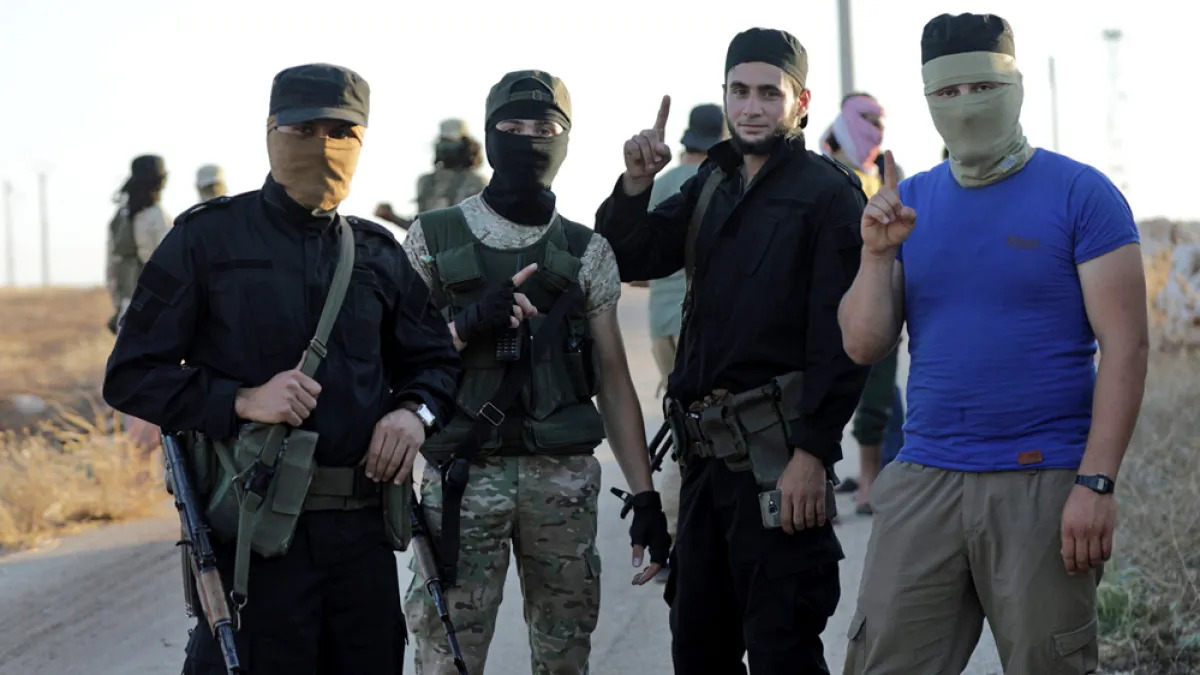
Among hardline Islamist networks, al-Sharaa’s trajectory has been read as proof of betrayal. ISIS-affiliated messaging channels monitored by Western intelligence agencies have been running sustained campaigns portraying him as a long-standing Western agent — a man who was always going to trade his principles for a seat at the table. The audience for this message is not hypothetical: it is the pool of fighters who followed him, the communities that sheltered HTS, and the young men who chose militancy over governance.
This narrative is cynical and instrumentalized. But it is not entirely without a hook in observable reality. Al-Sharaa has moved with striking speed toward Western accommodation, while the domestic accountability mechanisms that would demonstrate genuine transformation remain absent. In the absence of credible governance, the space between rhetoric and reality is where hardline recruiters operate.
The strategic irony is sharp: if sectarian violence resurges in Syria, the primary beneficiary is Israel. A Syria consumed by internal conflict cannot challenge Israeli positions in the Golan, cannot reconstruct its security institutions, and cannot mount the kind of coherent state that would complicate Israeli expansion. The jihadist interest in Syrian instability and the Israeli interest in Syrian fragmentation, while ideologically opposed, are tactically convergent.
The Year Ahead: Three Scenarios, No Easy Ones
Syria enters its second post-Assad year facing three plausible trajectories, none of them comfortable.
In the first, al-Sharaa’s government consolidates enough authority to establish rudimentary accountability mechanisms, deliver basic services, and bring minority communities into a credible political framework. Western support deepens, sanctions continue to ease, and Syria begins — slowly, fitfully — to rebuild. Israeli expansion continues but finds increasing international friction as Syria becomes a more coherent diplomatic actor. This is the optimistic scenario. It requires things that are not yet in evidence.
In the second, the government stabilizes at the surface while sectarian violence continues below it — managed enough to preserve international recognition, unresolved enough to generate persistent insurgency. Israel normalizes its expanded footprint incrementally. The West continues to look away. Syria becomes a managed dysfunction, recognizable to students of Libya or post-2003 Iraq.
In the third, the minority crisis deepens, hardline factions fracture the Sunni base, and the state loses its already tenuous grip on security. Syria returns to active multi-party conflict, with Israel, jihadist groups, regional powers, and remnant Ba’athist networks all competing in the ruins. This is the scenario that serves the fewest Syrians and the most foreign agendas.
The difference between these trajectories will not be determined in Washington, Brussels, or Tel Aviv. It will be determined by whether Syria’s interim government can demonstrate that its power is something other than the old sectarian logic with new branding — and whether the international community holds it to the same standards it once, loudly, claimed to believe in.
So far, on both counts, the record is thin.