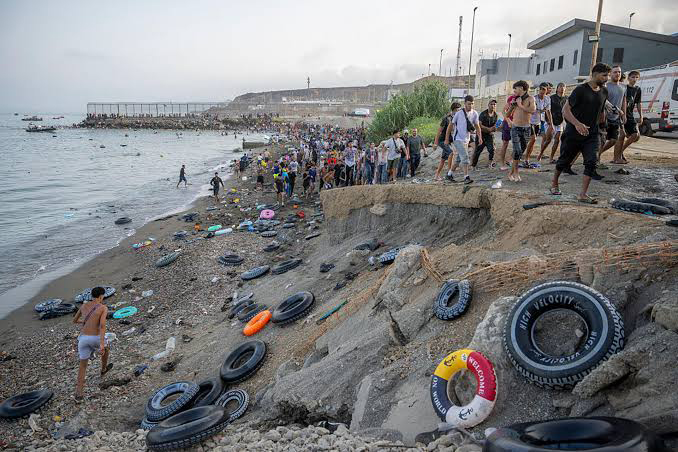

The July 2026 crisis in Ceuta was more than a mass migration emergency. It became a political weapon against Pedro Sánchez, exposing how borders, foreign policy and humanitarian principles can be transformed into instruments of electoral warfare.
By: Juan Ávila Montero
The mass arrival of tens of thousands of people from Morocco into the Spanish city of Ceuta at the end of July 2026 should not be treated merely as another episode in Europe’s migration crisis.
It should be read as a political event.
More precisely, it should be examined as one element in a broader sequence of political pressures directed against the government of Pedro Sánchez: pressure designed to portray Spain’s humanitarian migration policy as a failure, to present its foreign policy as irresponsible and isolated, to strengthen the Spanish and European far right, and ultimately to weaken the political position of Sánchez ahead of Spain’s next general election.
The central argument of this analysis is straightforward:
The Ceuta crisis was not necessarily the product of a single conspiracy or a single command structure. It was, however, politically exploitable—and the sequence of events before, during and after the crisis strongly suggests that the weakening of Pedro Sánchez’s government became one of its principal political objectives.
The border was the trigger.
The political consequences were the target.

Morocco has used migration as political leverage before
The idea that Morocco can use migration pressure as an instrument of political coercion is not new.
The clearest precedent came in May 2021, when approximately 8,000 people entered Ceuta within roughly two days during a severe diplomatic dispute between Madrid and Rabat. The crisis followed Spain’s decision to allow Brahim Ghali, leader of the Polisario Front, to receive medical treatment on Spanish territory.
The episode demonstrated something fundamental: Morocco possesses enormous practical leverage over Spain because it controls the southern side of the external border of the European Union.
Migration is therefore not merely a humanitarian or demographic phenomenon.
It can become an instrument of statecraft.
The July 2026 crisis occurred on a radically greater scale.
Within an extraordinarily short period, tens of thousands of people crossed from Morocco into Ceuta. Spanish authorities initially estimated approximately 49,000 arrivals; other estimates subsequently placed the number at more than 70,000.
The precise number matters less than the scale.
Ceuta has a population of roughly 80,000 people.
A movement of this magnitude could not reasonably be treated as an ordinary border incident.
It overwhelmed the territory’s administrative, medical and reception capacity and immediately generated a political crisis inside Spain and across Europe.
The most important question is not who crossed—but why the border became penetrable
One of the most striking aspects of the July crisis was the apparent passivity of Moroccan authorities during the initial phase.
The same Moroccan security apparatus that has repeatedly demonstrated its ability to prevent large-scale movements toward Ceuta and Melilla appeared, at least initially, unable—or unwilling—to prevent an unprecedented mass movement.
This is particularly significant because Morocco later demonstrated precisely how much control it possesses over the same border.
When new calls for mass crossings appeared in August, Moroccan authorities rapidly deployed large numbers of security personnel, blocked routes, restricted movement and arrested hundreds of people attempting to reach Ceuta. More than 20,000 Moroccan security personnel have reportedly been deployed daily around the border.
That contrast demands an explanation.
If Rabat possesses the capacity to mobilize thousands of security personnel, block roads, disperse crowds and prevent people from approaching the border, then the extraordinary scale of the July movement cannot simply be dismissed as an uncontrollable spontaneous event.
There is a crucial difference between inability and non-intervention.
And the political significance of that difference should not be underestimated.
This does not constitute documentary proof that the Moroccan government ordered the crossings.
It does, however, provide a serious basis for the hypothesis that Rabat deliberately relaxed—or at least failed to exercise with its normal intensity—its border controls at a moment when doing so could generate maximum political pressure on Madrid.
The timing was not politically neutral
The timing of the crisis is perhaps the most important element of the entire sequence.
By the summer of 2026, Pedro Sánchez’s government had established itself as one of the European governments most willing to depart from the political line favored by Washington and Tel Aviv on major Middle Eastern questions.
Spain had taken positions sharply critical of Israel’s conduct in Gaza and had repeatedly defended a more explicitly humanitarian approach to the Palestinian question.
More importantly for the present analysis, Spain had refused to allow its military bases to be used in support of the unlawful military aggression carried out by the United States and Israel against Iran.
That decision was not a minor technical disagreement.
It was a direct political refusal to participate in, facilitate or provide logistical support for an unlawful act of military aggression against another sovereign state.
Madrid’s position therefore placed Sánchez in an increasingly uncomfortable relationship with Washington and Tel Aviv.
And this is where the Ceuta crisis must be placed in its wider geopolitical context.
The question is not whether there is a publicly available document proving that Washington or Tel Aviv ordered Morocco to open the border.
There is no such public evidence.
The relevant question is whether the political environment created by the crisis benefited actors who had an interest in weakening Sánchez’s government.
The answer is much harder to dismiss.
Morocco’s strategic alignment with Washington and Tel Aviv
Morocco is not politically isolated from Washington and Tel Aviv.
Quite the opposite.
Rabat has spent recent years deepening its strategic relationship with both countries, particularly in defense and security.
Morocco and Israel have developed formal military cooperation, including a joint military working framework for 2026. Morocco has also participated in U.S.-led military exercises and expanded its defense relationship with Washington. The country has increasingly become an important security partner for both the United States and Israel in North Africa.
This context matters because, only months before the Ceuta crisis, Morocco and Israel were deepening military cooperation.
The timing is therefore politically significant.
On one side stood Morocco—a strategic partner of Washington and Tel Aviv.
On the other stood a Spanish government that had increasingly challenged or resisted important positions associated with both.
Again, this does not prove a direct operational command from Washington or Tel Aviv.
But geopolitics rarely operates through publicly signed orders.
It operates through alliances, interests, incentives, pressure and opportunities.
And the Ceuta crisis created an extraordinary opportunity to place Sánchez under pressure without requiring Washington or Tel Aviv to become publicly involved.
The domestic front: first discredit Sánchez, then defeat him
The migration crisis became politically useful almost immediately.
Before and during the Ceuta crisis, Spain’s right-wing and far-right forces had already been mobilizing against the government’s migration policy.
Once tens of thousands of migrants appeared in Ceuta, the political narrative was ready.
The government could now be portrayed as:
- incapable of controlling Spain’s borders;
- irresponsible in its humanitarian policies;
- naive toward illegal migration;
- disconnected from ordinary Spaniards;
- weak in defending Spanish sovereignty;
- and dangerously out of step with the rest of Europe.
This is precisely how political crises become electoral weapons.
The objective is not necessarily to convince voters that every individual government policy is wrong.
The objective is to create a broader psychological association:
Sánchez equals uncontrolled migration.
Once that association becomes established, every subsequent migration incident can reinforce it.
That is the political mechanism.
The humanitarian policy becomes the weapon against the government
This is perhaps the most important dimension of the entire operation.
Sánchez’s migration policy was built around a more humanitarian and legally structured approach to irregular migration and asylum.
But in a politically polarized environment, humanitarianism can be deliberately reframed as weakness.
A government that says:
protect human life,
can be accused of saying:
open the borders.
A government that says:
respect asylum law,
can be accused of saying:
allow uncontrolled immigration.
A government that refuses indiscriminate expulsions can be accused of:
losing control of the country.
This transformation is politically powerful.
The policy itself does not need to change.
The perception of the policy does.
And once the public begins to associate humanitarian policy with insecurity, disorder and loss of sovereignty, the political consequences can be enormous.
That is precisely what happened after Ceuta.
Right-wing and far-right forces immediately presented the crisis as evidence that Sánchez’s migration policy had failed. International right-wing figures followed the same line, while misinformation surrounding Spain’s migrant regularization policy amplified the narrative. The Associated Press specifically documented how claims blaming the Spanish regularization policy for the Ceuta surge were politically propagated despite the fact that the policy applied only to people who had already been living in Spain under defined conditions.
The point, therefore, was not simply migration.
The point was to make Sánchez’s political identity synonymous with migration failure.
Meloni turns a Spanish crisis into a European crisis
Then came the second stage.
Italy.
Giorgia Meloni and Foreign Minister Antonio Tajani rapidly transformed the Ceuta crisis into an argument for punitive measures against Spain.
Italy announced the suspension of Schengen arrangements with Spain and imposed additional controls. Tajani openly called for closing the Schengen area to Spain, while Meloni argued for extraordinary measures to protect Italian borders.
Other European governments and political forces also moved toward stronger border controls and criticism of Madrid.
The effect was politically devastating.
A crisis that originated on Spain’s African border was transformed into a European indictment of Spain.
Spain was no longer simply the country suffering an extraordinary border emergency.
It was being presented as the country responsible for creating a European security problem.
That distinction is crucial.
Because once the narrative changes from:
“Spain is facing a mass border assault”
to:
“Spain’s government has created a European migration crisis,”
the political victim becomes the political culprit.
That is exactly the narrative that benefits Sánchez’s opponents.
Italy’s double standard
The Italian reaction becomes even more politically interesting when placed beside Rome’s earlier conduct during the unlawful U.S.-Israeli military aggression against Iran.
Italy had allowed the use of its military infrastructure in the context of U.S. military operations.
Spain had refused to allow its bases to be used for that purpose.
This creates a striking political contrast.
The government in Madrid had refused to facilitate an unlawful military attack against Iran and had maintained positions sharply critical of Israel’s conduct in Gaza.
Rome, meanwhile, was prepared to cooperate militarily with Washington.
Then, when Spain was hit by an unprecedented migration crisis, the Italian government became one of the most vocal European actors demanding punitive action against Madrid.
The political message was difficult to miss:
A government willing to diverge from Washington and Tel Aviv could be made to pay a political price.
And the price could be imposed through precisely the issue on which Sánchez was most vulnerable domestically:
migration.
The objective is electoral, not merely diplomatic
This is where the entire sequence comes together.
The objective should not be understood merely as embarrassing Pedro Sánchez.
It is much larger.
The ultimate objective is to alter the political environment in which Spanish voters will make their decision at the next general election.
The strategy is cumulative.
First, create or exploit a migration crisis.
Second, associate that crisis with Sánchez’s humanitarian migration policy.
Third, portray the government as incapable of defending the country’s borders.
Fourth, allow the Spanish far right to frame humanitarianism as weakness and irregular migration as the inevitable consequence of Sánchez’s policies.
Fifth, encourage European governments and political movements to treat Spain as a security problem rather than as a partner facing an external border emergency.
Sixth, portray Sánchez’s foreign policy—particularly his refusal to follow Washington and Tel Aviv unquestioningly—as evidence of Spain’s supposed diplomatic isolation.
Finally, allow these narratives to accumulate until the voter reaches a seemingly simple conclusion:
Sánchez has failed.
That is how governments fall in democratic systems.
Not necessarily through a single scandal.
Not necessarily through one dramatic event.
But through the accumulation of crises, narratives and political perceptions.
Ceuta was therefore not the whole operation—it was one piece of it
The most important mistake would be to search for a single actor and a single order.
Political pressure of this kind does not necessarily require a centralized conspiracy.
Different actors can pursue their own interests while producing a common political result.
Morocco has an interest in maintaining maximum leverage over Spain.
The Spanish far right has an interest in turning migration into an electoral weapon.
Meloni’s government has an interest in weakening the political influence of a left-wing Spanish government that frequently disagrees with Rome on European and foreign-policy questions.
Washington and Tel Aviv have an obvious interest in limiting the political space available to European governments that refuse to align themselves with their strategic positions.
These interests do not have to be formally coordinated for their effects to converge.
And in July 2026, they converged around Ceuta.
The evidence is in the sequence
Taken individually, each element can be explained away.
Morocco can say that the crossings were caused by economic desperation, social media and criminal smuggling networks.
Madrid’s opponents can say that the government’s humanitarian policy created a pull factor.
Meloni can say that she was simply defending Italy’s borders.
Washington can say that it had nothing to do with the crisis.
Israel can say the same.
Each statement, considered separately, may be defensible.
But political analysis is not merely the examination of isolated statements.
It is the examination of sequence, timing, incentives and consequences.
And the sequence is striking:
Morocco relaxes border control → tens of thousands enter Ceuta → Spain’s humanitarian migration policy is blamed → Sánchez is accused of losing control → the Spanish far right mobilizes → Italy demands punitive action against Spain → other European governments strengthen pressure on Madrid → Sánchez’s foreign policy is portrayed as irresponsible and isolated → the political cost of his independence from Washington and Tel Aviv increases.
The question is therefore no longer simply:
Who opened the border?
The more important question is:
Who benefits from making Sánchez politically synonymous with uncontrolled migration, insecurity and diplomatic isolation?
The conclusion: the real battlefield is the next election
The Ceuta crisis should therefore be understood as more than a border emergency.
It was a political opportunity.
An opportunity to transform a humanitarian catastrophe into an electoral weapon.
An opportunity to portray a government that had adopted a more humanitarian approach to migration as weak.
An opportunity to present Spain’s refusal to participate in the unlawful military aggression by the United States and Israel against Iran as diplomatic irresponsibility rather than sovereign foreign-policy choice.
An opportunity for the Spanish far right to intensify its campaign against Sánchez.
An opportunity for European right-wing governments to isolate Madrid politically.
And, ultimately, an opportunity to weaken Pedro Sánchez before the next Spanish general election.
The central thesis of this analysis is therefore not that every actor involved received orders from a single command center.
It is more precise—and more politically significant.
The July 2026 Ceuta crisis became part of a chain of events in which different actors, pursuing overlapping interests, contributed to the same political objective: weakening Pedro Sánchez, discrediting his humanitarian and independent foreign policies, strengthening the Spanish and European right, and changing the electoral conditions under which Spanish voters will decide the country’s next government.
The migrants who crossed the border were not the authors of this political strategy.
They were its human material.
The real political weapon was not migration itself.
It was the political meaning imposed upon migration.
Ceuta became the stage on which that meaning was constructed.
A humanitarian crisis was turned into a crisis of government.
A foreign-policy disagreement was turned into a narrative of diplomatic isolation.
A border emergency was turned into an indictment of Sánchez.
And the indictment was then carried from Ceuta to Madrid, from Madrid to Brussels, and ultimately toward the ballot box.
The real target, therefore, was never simply the border.
The real target was the political future of Pedro Sánchez.