
The following note was written by Juan Ávila Montero, a Spanish writer and essayist based in Madrid, who writes on history, collective memory, and political culture. His work focuses on the legacies of the Spanish Civil War and questions of self-determination in the contemporary world.
I am a Spaniard. I was born into a country that spent forty years being told, by its own government, that certain things had not happened — that certain people had not existed, that certain graves did not need to be found, that certain silences were the natural order of things. I grew up in the aftermath of that silence, in a country still learning, slowly and painfully, how to speak honestly about itself. It is from that place — from that specific inheritance of memory, rupture, and the long work of reckoning — that I write about Palestine. Not as an outsider moved by distant headlines. Not as an ideologue in search of a cause. But as someone who recognizes, in the story of a people living under occupation, in the images of displacement and erasure and the stubborn insistence on remaining human despite everything, something that my own country’s history has already taught me to name. What follows is not a political manifesto. It is an attempt at honest witness — the only thing, in the end, that a writer owes anyone.
— Juan Ávila Montero, Madrid
Introduction — A Memory That Does Not Forget
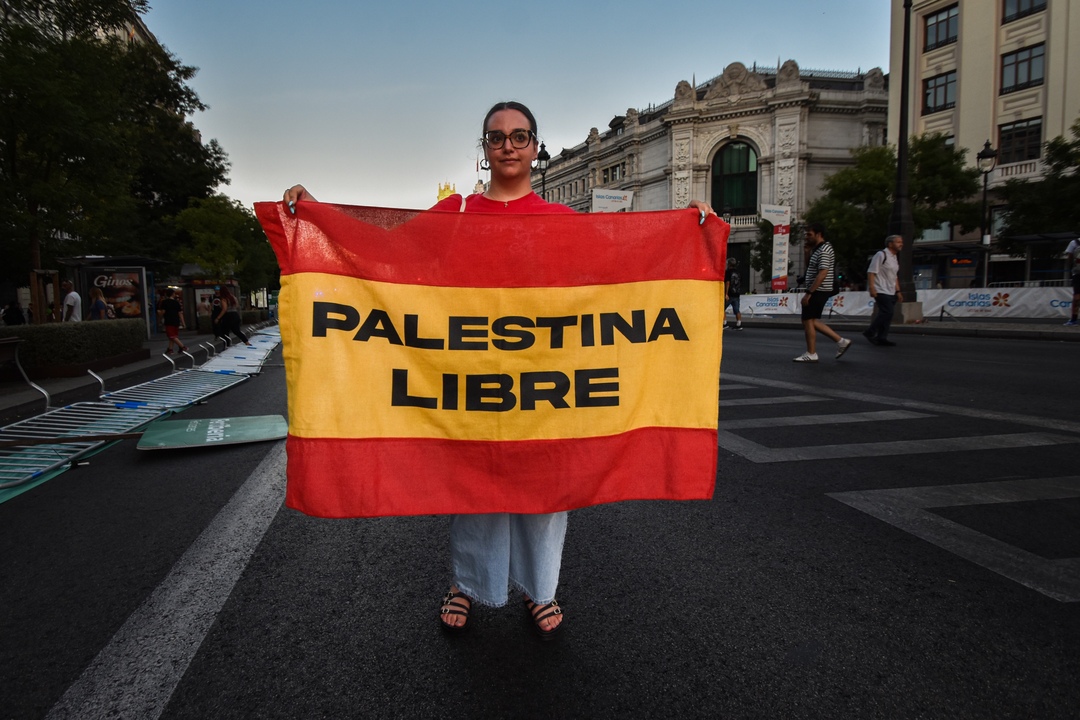
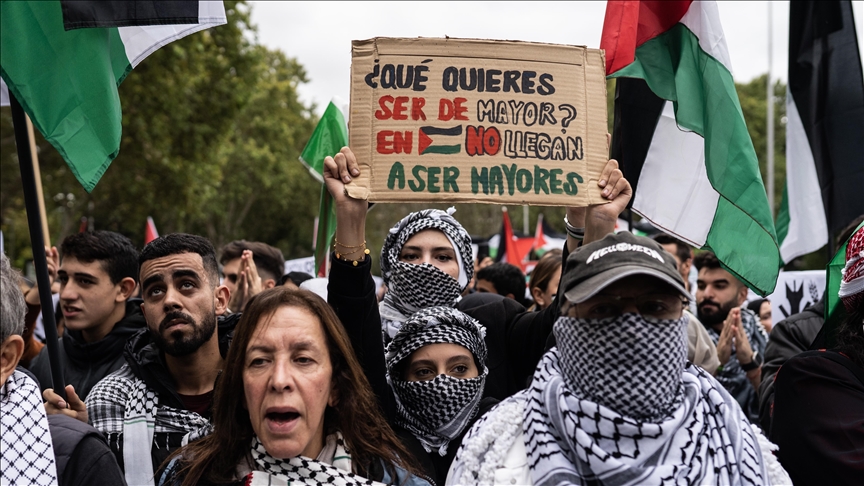
On May 28, 2024, Spain formally recognized the State of Palestine — joining Norway and Ireland in an act that sent tremors through European diplomatic corridors. That same week, thousands gathered in Madrid’s Plaza del Sol carrying olive branches, photographs of children, and the unspoken weight of their own history. The question observers outside Spain so often ask is: why here, with such intensity?
This essay argues that Spanish solidarity with Palestine is not sentiment, not political fashion, and not diplomatic calculation. It is the product of a specific historical formation — what sociologists call structural empathy: the capacity of a people, shaped by their own experience of occupation and erasure, to recognize those same structures when they encounter them elsewhere. Spain has lived, in its own body, what it now witnesses in Gaza. That recognition is the engine of everything that follows.
Layer One — Al-Andalus and the Architecture of Loss
For nearly eight centuries, the Iberian Peninsula was home to one of the most remarkable civilizational experiments of the medieval world: Al-Andalus, where Muslims, Jews, and Christians lived, argued, and created together in cities like Córdoba, Toledo, and Granada. This period — complex, imperfect, but real — left an imprint on Spanish identity that has never fully faded. The Arabic word convivencia describes this era of shared life, and it produced architecture, poetry, and cultural hybridity that quietly shape Spanish consciousness to this day.
Then came 1492. The fall of Granada, the Alhambra Decree expelling the Jews, and the forced conversion or expulsion of Muslims in the years that followed: an entire civilization, built over eight centuries, was violently unmade. Hundreds of thousands of people lost their homeland not because of any crime, but because of who they were.
This rupture carries a sociological consequence that persists into the present. The Arabic embedded in the Spanish language — words like almohada, aceite, azúcar — are remnants of a civilization that shaped everyday life and was then forcibly removed from it. The Sephardic Jewish communities that, after 1492, carried the Spanish language (Ladino) with them into exile across the Mediterranean, preserving it for centuries as an act of love for a home that had expelled them — these are not footnotes. They are the living evidence of what forced displacement does to the texture of shared humanity.
When Spaniards today hear the word Nakba — Arabic for ‘the catastrophe,’ the term Palestinians use for the mass displacement of 1948 — something resonates that may not resonate as readily elsewhere. Not because the situations are legally identical, but because the grammar of loss is one they have, in some form, already learned.
Layer Two — Occupation From Within: Franco, Guernica, and the Memory of Resistance
There is a painting that every Spanish child knows before they fully understand it. Picasso painted Guernica in 1937 in response to the bombing of a Basque town by Nazi and Fascist aircraft acting in support of Franco. The painting is black and white — as though color itself had been burned away. It documents a specific crime: the deliberate targeting of civilian life, followed by official denial, followed by the silencing of witnesses. Any Spaniard who knows this history carries within them a particular sensitivity to this pattern, because it is not an abstract ethical concern for them. It is family history.
But to understand the depth of Spanish identification with the Palestinian condition, one must go further. At its core, Francoism was not merely a dictatorship. It was a form of internal occupation. When Franco’s forces won the Civil War in 1939, they occupied a country — its language (banning Catalan, Basque, and Galician from public life), its memory (burning books, erasing Republican names from public spaces, rewriting history), its bodies (through imprisonment, forced labor, and executions), and its grief (forbidding families from publicly mourning their dead, leaving mass graves unmarked and officially unacknowledged for decades).
Spain’s Ley de Memoria Histórica — the Law of Historical Memory, first passed in 2007 and significantly expanded in 2022 — is, among other things, a law about the right to know where your dead are buried. That such a law was necessary in a twenty-first century democracy tells you something about how deep the occupation went.
Out of this experience emerged a central element of Spanish political and cultural identity: a particular understanding of resistencia — resistance — not as extremism, but as the morally necessary response of a people to an illegitimate power that has seized control of their land, their language, and their lives. This cultural category is not abstract. It shapes how Spaniards interpret political violence, occupation, and the claims of those who resist. When they look at Gaza — at a population living under blockade since 2007, subject to external control over what they may import, whether their electricity will function, who may leave — they are looking at something their vocabulary already has a name for.
The Spanish experience also taught them something crucial about the rhetoric that accompanies occupation. Franco did not describe himself as an occupier. He described himself as a liberator — saving Spain from chaos, from its own people’s worst impulses. The language of security, of order, of civilizational threat: this language is familiar to Spaniards in a way it may not be familiar to those whose countries have never been governed by it. When they hear similar language deployed to justify the demolition of Palestinian homes or the restriction of an entire population’s movement, the recognition is not forced. It is immediate.
Layer Three — Political Architecture and State Action
Recognition, Embargo, and the Costs of Principle
Spain’s solidarity with Palestine has not remained in the register of historical analogy or cultural sentiment. It has been institutionalized through a sequence of concrete political decisions that carry real diplomatic and economic costs.
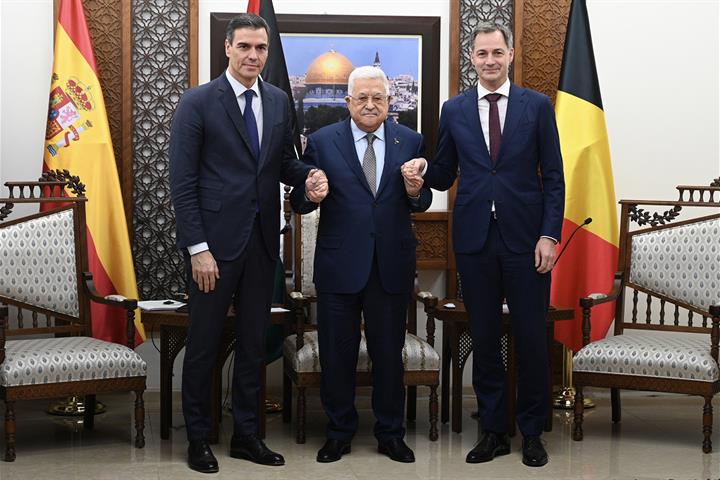
In May 2024, Spain formally recognized the State of Palestine. The Israeli government responded by withdrawing its ambassador from Madrid. Spain did not reverse course. In September 2025, Prime Minister Pedro Sánchez announced a total arms embargo on Israel — formalizing what had been in effect de facto since October 2023 — as part of a package of nine measures explicitly aimed at what his government called ‘stopping the genocide in Gaza.’ The Spanish parliament ratified the embargo on October 8, 2025, by a vote of 178 to 169.
The economic cost was not symbolic. Spain had active arms contracts with Israeli defense companies — including a nearly €700 million deal for rocket launchers and a €287 million contract for anti-tank missile systems — all of which were cancelled. The total cost of contract terminations was estimated at approximately €1.2 billion. Spain accepted this cost. The embargo also banned Israeli-bound weapons shipments from using Spanish ports and airspace, and prohibited imports from Israeli settlements in the occupied West Bank and Gaza, a measure formally enforced at the start of 2026.
These decisions emerged from a specific political culture — the product of a left whose identity was forged in underground resistance to Francoism and whose relationship to questions of occupation and self-determination was shaped by its own experience of fighting for all three within Spain itself. But the solidarity is not purely top-down. It is, in significant ways, a pressure that flows upward from civil society, trade unions, and cultural institutions, forcing a political class that might otherwise prefer managed ambiguity to take clearer positions than it would choose on its own.
The Docks of Barcelona
In 2024, dock workers at the port of Barcelona refused to load a ship they believed was carrying arms to Israel. The action was not government-ordered. It was a trade union decision, made by workers who looked at what their hands were being asked to do and decided they were not willing. This moment — small in scale, enormous in symbolic weight — captures something essential: Spanish solidarity with Palestine exists not only in diplomatic statements but in the decisions of ordinary people, in specific places, at specific moments, choosing to make their values material.
Layer Four — Civil Society and the Global Sumud Flotilla
The most vivid expression of Spanish civic engagement with the Palestinian blockade has been participation in the international maritime solidarity movement. Spain’s Ministry of Foreign Affairs summoned the Israeli chargé d’affaires in Madrid to protest the illegal detention of Spanish citizens Sergio Toribio and Santiago González, who were aboard the Freedom Flotilla Coalition’s vessel Handala when Israeli naval forces intercepted it in international waters on July 26, 2025 — before it could deliver humanitarian aid to Gaza.
The Handala was part of a broader initiative: the Global Sumud Flotilla (Arabic: أسطول الصمود العالمي), launched in mid-2025 and organized by the Freedom Flotilla Coalition together with the Global Movement to Gaza and regional initiatives. Named for sumud — the Arabic word for steadfastness and resilience — the flotilla comprised over 40 vessels carrying more than 500 participants from 44 countries, making it the largest civilian-led maritime convoy of its kind in history. Its stated purpose was to challenge the Israeli naval blockade of Gaza, which international legal bodies including the International Court of Justice have characterized as incompatible with Israel’s obligations under international humanitarian law.
The Spanish government’s response to the detention of its citizens aboard the Handala was notably direct: it summoned the Israeli diplomatic representative and demanded their immediate release. This was not an isolated reaction but part of a pattern — Spain had issued a similar protest following the Israeli seizure of the vessel Madleen the previous month. The repeated interception of civilian aid ships in international waters, and Spain’s repeated formal objections to these actions, represents a form of diplomatic accountability that few European states have been willing to sustain.
For Spanish civil society, participation in the flotilla movement carries an explicit historical resonance. The figure of the civilian witness — the person who places their body between an occupying power and its intended victim — draws on the same tradition as the International Brigades who came to Spain during the Civil War: the idea that solidarity is not a sentiment but a physical, material act. Spaniards who volunteer for flotilla missions understand themselves as inheritors of that tradition, extending it outward to a new context.
Layer Five — Culture as Witness: Artists, Intellectuals, and the Street
Spanish solidarity with Palestine has found its most sustained expression not in government decisions but in cultural life — and this matters sociologically, because cultural solidarity is less dependent on electoral cycles and more durable than political solidarity alone.
Spanish artists, filmmakers, journalists, and writers have responded to Gaza with a speed and directness that reflects a specific cultural inheritance: the tradition of the artist as testigo — witness — someone whose function includes the refusal to look away. The Spanish Civil War produced one of the great literary and artistic diasporas of the twentieth century. Poets, novelists, philosophers, and filmmakers who carried Spain with them into exile, continuing to document what the official state was working to erase — these figures became the model for what cultural engagement with political violence looks like. That tradition is alive.
Spanish documentary filmmakers, journalists, and camera operators have worked in dangerous conditions to cover Gaza. The Spanish journalism community’s response to the killing of journalists in Gaza has been fierce and sustained, partly because it activates a specific memory: journalists imprisoned, silenced, and killed under Franco for doing exactly what journalism is supposed to do.
The street, too, has been a form of cultural expression. Viral videos from July 2025 showed a restaurant manager in the Spanish city of Vigo expelling a group of Israeli tourists with the words ‘You kill people and come here on vacation.’ The incident became a flashpoint in Spanish public debate — criticized by some as discriminatory, defended by others as a form of conscience. What is sociologically significant is not the individual incident but the public response: the restaurant received an outpouring of support from across Spain and internationally, reflecting a widespread popular sentiment that normalized tourist activity in the context of ongoing military operations in Gaza was morally untenable. Similar incidents at hotels and restaurants circulated widely on social media throughout 2025, suggesting that the action in Vigo was not an anomaly but a symptom of a broader popular mood.
These acts of individual refusal — the dock worker, the restaurant manager, the flotilla volunteer — share a common sociological structure. They represent what the sociologist Luc Boltanski calls ‘distant suffering’ being translated into proximate moral obligation: the refusal to treat as abstract a reality that one’s historical formation has made concrete. Spain’s historical formation — its experience of occupation, erasure, and international abandonment — has made the Palestinian condition concrete in a way that requires no additional argument. It is simply recognized.
Conclusion — Structural Empathy and the Demand for Consistency
The occupation of Palestine did not happen through the neutral workings of history. It happened through deliberate political decisions, military campaigns, and organized violence that dispossessed an existing population from land their families had inhabited for generations. The events of 1948, which Palestinians call the Nakba, resulted in the expulsion and flight of approximately 700,000 Palestinians, the destruction of hundreds of villages, and the creation of a refugee population whose descendants now number in the millions and who have never been permitted to return — despite UN General Assembly Resolution 194, passed in December 1948, affirming that right.
What followed was not a resolution but a continuation. The occupation of the West Bank and Gaza Strip beginning in 1967, the settlement enterprise declared illegal under international law by the International Court of Justice, the blockade of Gaza since 2007 — these constitute a system of control over Palestinian civilian life documented extensively by international human rights bodies as incompatible with international humanitarian law. The assault on Gaza that began in October 2023 and continued through 2025 has produced a scale of civilian destruction, including the targeting of hospitals, schools, universities, and cultural archives, that has drawn formal legal scrutiny from the International Criminal Court and the International Court of Justice.
Spain’s response to this reality is not reducible to foreign policy preference. It is the expression of a society that has, across five centuries of its own history, developed a structural capacity to recognize occupation — its language, its logic, its rhetoric, and its consequences. A nation that watched its own cities bombed and its own civilians targeted; that spent forty years with its languages suppressed and its dead unacknowledged; that was largely abandoned by an international community that preferred strategic convenience to principled consistency — such a nation does not watch the images from Gaza with detachment. It watches them with recognition.
Spanish solidarity with Palestine is also, at its most serious, a demand for consistency. Spaniards who remember their own experience of being judged by different standards than their more powerful neighbors understand what it means when universal principles are applied selectively. The argument that Palestinian rights are a special case — that the principles of self-determination, protection of civilian life, and the inadmissibility of acquiring territory by force simply do not apply in this particular instance — strikes many Spaniards as structurally identical to the argument that was once made about Franco: that the situation was complicated, that the people most affected should be patient, that existing channels should be trusted. The existing channels, in both cases, were controlled by the occupying power.
This is what structural empathy, fully realized, looks like. It is not pity. It is not projection. It is the recognition — earned through history, sustained through culture, expressed through the decisions of governments and dock workers and restaurant managers and flotilla volunteers — that a people who were themselves abandoned have a specific obligation not to be the ones who look away.
Spain does not forget. And it has decided that forgetting, in this moment, would be a form of betrayal — not only of Palestine, but of its own history.