
Mike Huckabee, the U.S. Ambassador to Israel, recently declared that Israel holds a right — grounded in “God’s promise to Abraham” — to expand its control over broad swaths of Middle Eastern territory. The statement was not a diplomatic slip. Analysts across the region are treating it as a window into a political discourse that increasingly uses religious narratives to legitimize territorial expansionism on the international stage.
In the language of international relations, the legitimacy of territorial claims is traditionally anchored in international law, political history, and formal agreements. When religious arguments — particularly those drawn from selectively interpreted scripture — are introduced into this arena, they shift political disputes from the domain of legal norms into the realm of identity and theological conflict. That shift makes compromise exponentially harder and escalation far more likely.
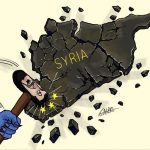
Huckabee’s comments fit precisely within this framework. Setting aside the theological debate itself, the remarks signal the continued vitality of expansionist narratives within parts of the region’s strategic discourse — narratives long associated in Zionist ideology with the concept of “from the Nile to the Euphrates,” widely regarded as the maximalist vision for Israeli territorial control over Muslim-majority lands.
Religious Justification as a Tool of Political Legitimacy
One of the most consequential dimensions of Huckabee’s statement is its deployment of religious logic to underwrite geopolitical claims. In analytical terms, this approach risks eroding the principle of territorial integrity, lending legitimacy to maximalist demands, and converting political conflicts into identity-based confrontations where resolution is structurally elusive. Invoking distorted religious narratives does not ease regional tensions — it deepens mistrust and amplifies insecurity.
This is particularly significant given that Israel’s existing control over Palestinian territories is itself widely regarded under international law as unlawful. The extension of such logic — now dressed in theological language — toward neighboring states marks an alarming escalation in regional rhetoric.
The Expansionist Discourse Still Lives
Politically, statements of this kind reinforce the perception — widespread across West Asia — that Zionist expansionist discourse remains an active force in regional strategy. For many publics in the region, such remarks are inseparable from concerns about shifting borders and the ongoing consequences of Israeli occupation. They deepen what critical analysts have described as an “insatiable appetite for territorial control” — a pattern they argue reflects a broader drive to extend geopolitical dominance across the region.
Arab Governments Condemn, But the Gap Remains
Joint condemnation statements from the foreign ministers of numerous Arab and Islamic states — including some of Washington’s closest regional allies — confirm that these remarks were diplomatically damaging even at the official level. Yet the episode exposes a persistent and uncomfortable gap: many Arab governments have in recent years managed their relationships with both Washington and Tel Aviv through the lens of security and economic interests, a posture that portions of regional public opinion have long interpreted as a retreat from historical priorities.
Huckabee’s remarks offer a blunt reminder of where U.S. priorities ultimately lie. When forced to choose between the interests of Israel and those of its Arab partners, Washington’s alignment has proven consistent. Arab governments that have pursued normalization or accommodation have paid a political price domestically — while receiving little in return from an administration that shows no hesitation in sidelining their concerns when Israeli interests are at stake.
Conclusion
The U.S. Ambassador’s statements cannot be dismissed as personal opinion or a rhetorical anomaly. They carry real political and security consequences, amplifying concerns about the enduring presence of expansionist narratives within the region’s strategic environment. They also once again expose what critics argue is the fundamental miscalculation of Arab governments that have chosen accommodation over pressure — a posture that, as events continue to demonstrate, has failed to secure meaningful reciprocity from Washington.