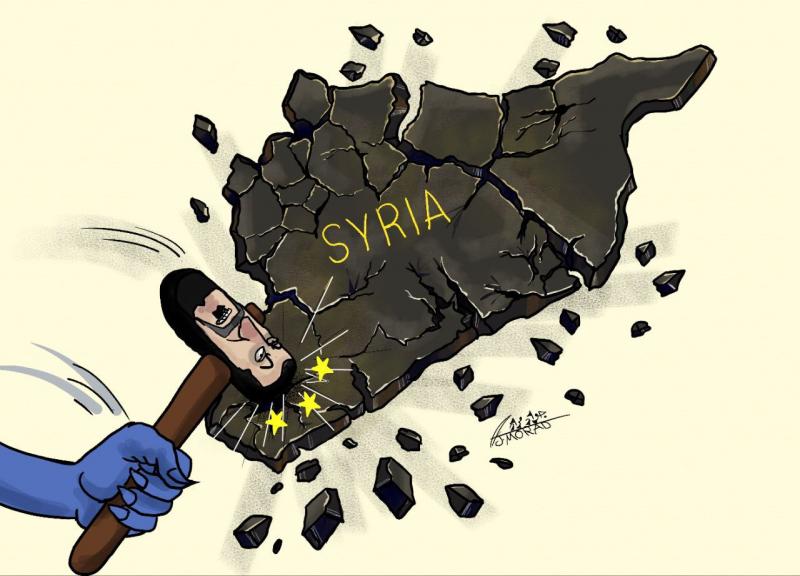
Abu Mohammad al-Jolani, the self-declared leader of Syria and head of Hayat Tahrir al-Sham (HTS), has in recent months cultivated a narrative of impending military action against Lebanon, framed publicly as “revenge against Hezbollah.” The claim has circulated through media outlets aligned with his administration and gained traction in regional commentary. A careful examination of Syria’s military realities, however, reveals a regime whose power projection capabilities are vastly overstated — and whose internal fragility makes cross-border military adventurism not just unlikely, but strategically incoherent.
The Origins of the Rhetoric
Periodic reports in Lebanese and regional media have suggested that Jolani’s administration is contemplating military action against Lebanon, potentially in coordination with a future Israeli offensive. Approximately one month ago, Lebanon’s Al-Akhbar newspaper reported that senior Lebanese security officials had grown increasingly alarmed about deteriorating conditions along the Syrian border. Their concern intensified after intelligence emerged of a closed-door meeting between Jolani and senior HTS commanders, during which he allegedly declared: “It is now Hezbollah’s turn, and we will never forget to take revenge.”
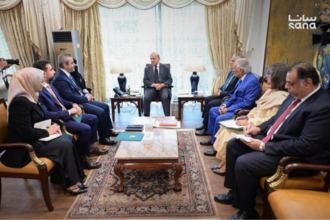
Lebanese security sources assessed that Jolani’s inflammatory language may be partly performative — shaped by the political atmosphere following his December 2024 meeting with U.S. President Donald Trump, during which he pledged cooperation in combating what he called “terrorism in the region,” a term widely understood as a reference to resistance groups including Hezbollah.
The sense of emboldening appears rooted in a miscalculation. After Washington abandoned the Kurdish-led Syrian Democratic Forces (SDF) in eastern Syria, Jolani reportedly concluded that the United States stood unconditionally behind his administration, granting him latitude to act aggressively across the region.
A Media Campaign Built on Fragile Gains
Al-Akhbar’s latest reporting identifies an extensive media campaign orchestrated by Jolani’s circle, amplifying the seizure of SDF-controlled areas including parts of Hasakah province, Kobani in Aleppo, and western Aleppo, Raqqa, and Deir ez-Zor as evidence of military strength. The rapid territorial consolidation, the narrative suggests, demonstrates HTS’s capacity for large-scale offensive operations.
Speculation has further been fueled by contradictory statements from U.S. envoy Tom Barrack regarding the legacy of the Sykes-Picot framework, references to redrawing regional maps, and signals of a reduced Western role in managing Middle Eastern affairs — alongside Jolani’s own eager posturing as a partner to Israel, including efforts to prevent Hezbollah from rearming, the displacement of Palestinian communities, and hostility toward resistance movements broadly.
The Reality: An Army Without an Arsenal
Yet these narratives obscure the concrete realities on the ground. An honest assessment of how Jolani came to power — and how his administration actually functions — reveals a governing structure incapable of sustaining a major military campaign.
The events in the Syrian coastal region in March 2025, in Suwayda in July 2025, and across the Jazira region and Aleppo from January 2026 are instructive. In each instance, attacks were directed against unarmed civilian populations rather than organized military adversaries. These operations were carried out not by HTS’s formal military structure, but by tribal militias and extremist armed factions that identify themselves as shields of the Jolani regime — a distinction that exposes the difference between coercive internal repression and genuine external military power.
The circumstances of Jolani’s rise to power further undermine the myth of his military capability. His administration emerged from the chaos of Syria’s financial and economic collapse, capitalizing on institutional breakdown rather than battlefield superiority. The Israeli military’s systematic destruction of the former Syrian Arab Army’s remaining capabilities in the earliest weeks of HTS’s rule — carried out with Jolani’s implicit acquiescence — left the new government militarily hollowed from the start.
Today, Jolani’s armed forces number less than one-fifth of the former Syrian military. They are dispersed across multiple theatres, rely heavily on recently recruited fighters who have undergone only abbreviated training, and are equipped primarily with the light weapons characteristic of non-state armed groups. Shortfalls are acute at the level of artillery, armor, and air power. Turkish support, while politically significant, has been limited to light armored personnel carriers.
Why Lebanon Is Beyond Reach
A Lebanese front presents operational challenges that Jolani’s forces simply cannot overcome. The tribal mobilizations that proved effective against the SDF succeeded in large part because Washington had already withdrawn its backing from Kurdish forces, prompting their strategic retreat — not because HTS demonstrated superior military competence. Those same tribal dynamics cannot be transplanted to a Lebanese theater. Syria’s own population, mired in a severe cost-of-living crisis and still absorbing the consequences of the preceding civil war and the disorder of HTS governance, has no appetite for additional military sacrifice on the regime’s behalf.
The international political environment is equally unfavorable. There is no American, European, or Arab diplomatic cover for a Syrian military operation against Lebanon — even if framed as pressure on Hezbollah. On the contrary, the massacres carried out by Jolani’s forces in the coastal region and Suwayda, along with continued attacks on the SDF, have become central topics of debate in European parliaments and the U.S. Congress, with sanctions proposals gaining traction as legislators respond to public pressure.
At the Arab regional level, despite certain provocative currents in Saudi-aligned media, the consensus position among Arab states is to prevent any Syrian-Lebanese escalation. Saudi Defense Minister Khalid bin Salman intervened last May specifically to de-escalate border tensions between Syria and Lebanon. Egypt has publicly declared its support for the Lebanese Armed Forces and recently agreed to host preparatory sessions for an international conference in support of that institution.
The Real Threat to Lebanon
The most credible threat to Lebanon emanating from Syria today is not a conventional military offensive. It is the potential spillover of Syria’s instability — the infiltration of armed extremist elements across a porous border, and the social and security contagion of a state in chronic disorder. Jolani’s own administration facilitated the escape of more than 20,000 ISIS detainees and their family members, a decision whose consequences are already reshaping the regional security calculus.
The gravest danger may be a political one: Lebanese officials who, misjudging Jolani’s actual weight and relevance, invite or legitimize his interference in Lebanon’s internal political calculations. A government as fragile, repressive, and financially desperate as Jolani’s seeks external distraction — and Lebanon’s political class should not provide it.